From Patent to Product: A Complete Journey
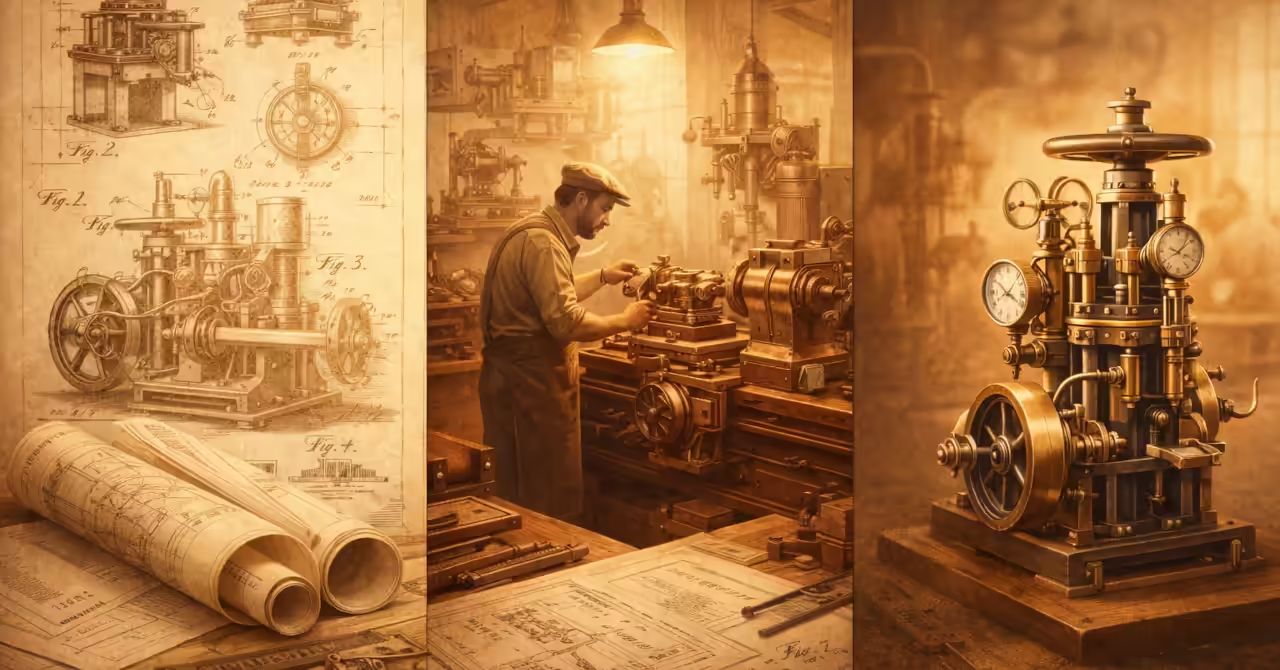
Patents, Factories, and the Finished Object
The journey from patent to product is often imagined as a neat line. An inventor conceives an idea, secures legal protection, and soon a finished object appears in the world. In practice, especially in 1890s industrial manufacturing, the path was more layered than that. A patent was not the product itself. It was a formal claim, a legal and technical statement that marked out a space of novelty. The finished product had to pass through many other conditions before it became a saleable thing. That is the relationship that matters here. A patent describes an invention in principle, while production turns that principle into something repeatable, affordable, distributable, and useful.
This distinction is worth holding firmly. The patent belongs to the world of rights, claims, and formal description. The product belongs to the world of materials, labour, machining, tolerances, supply, and trade. One may begin the other, but it does not contain the other in full. An industrial article from the 1890s carried within it not just invention, but manufacturing judgement. It reflected what could be cast, cut, rolled, finished, assembled, packed, shipped, serviced, and understood by the buyer. The distance between a patent drawing and an object on the merchant’s list is therefore not empty space. It is the whole field of industrial mediation.
That is why the phrase from patent to product remains so useful. It reminds us that invention only becomes industrial fact when it enters a chain of practical transformations. In that chain, each stage narrows some possibilities and opens others. The final product is not merely the patent made visible. It is the patent adapted to the realities of production and use.
Industrial Manufacturing Joined Law to Material Practice
In the 1890s, a patent could perform several roles at once. It could protect a specific mechanism, help attract investment, establish precedence over rivals, or lend authority to advertisements and catalogues. But the patent alone did not guarantee adoption. A protected idea still had to prove that it could be manufactured at viable scale and sold into an existing or emerging market. That meant moving from legal language into industrial process.
The transition depended on translation. A patent drawing and specification might state the arrangement of parts and the novelty being claimed, but manufacturers had to decide how those parts would actually be made. Which metals were available at suitable cost. Which workshops had the necessary tools. Which dimensions could be standardised. Which features were robust enough for repeated use. A patent may show an elegant mechanism in outline, yet production must decide whether that elegance survives contact with foundry work, machining limits, and the habits of the end user.
This was particularly important in the industrial world of the 1890s, where firms often operated within dense networks of suppliers, agents, subcontractors, and merchants. A single product might depend on castings from one source, turned fittings from another, standard fasteners from another, and final assembly elsewhere. It might then pass into catalogues, trade advertisements, and sales channels that had their own requirements for pricing, delivery, and after-sale support. The product emerged from this network as a commercial object, not as a patent alone.
Patent claims had to survive the workshop
The first major transformation happened between invention and manufacturability. A patented design could be ingenious on paper and still prove troublesome in the shop. Fine tolerances might increase cost. An unusual shape might be difficult to cast cleanly. A moving part might wear too quickly in ordinary service. A mechanism that looked compact in drawing form might be awkward to assemble or repair. These were not minor inconveniences. They shaped whether an invention could enter regular production at all.
This is where industrial judgement became decisive. Engineers, draughtsmen, foremen, and proprietors had to reduce uncertainty. They selected materials, simplified forms, substituted standard parts, and adjusted proportions. At times the patented principle remained intact while the physical expression changed. At other times the product that reached the market represented only the most workable portion of the original idea. What survived was not just the invention, but the invention after contact with cost, labour, and repeated manufacture.
In this sense, the workshop did not merely execute the patent. It interpreted it. The industrial product was a negotiated version of the invention, shaped by what could be made reliably and sold with confidence. That negotiation is easy to miss if one looks only at patent records or only at the finished artefact.
Manufacture also had to meet trade conditions
The second transformation occurred beyond the workshop floor. A product could be technically sound and still fail if it did not meet trade conditions. By the 1890s, many industrial goods circulated through catalogues, wholesalers, regional agents, and export channels. That meant the product needed a form suited not only to manufacture, but to sale and distribution. It needed names, grades, prices, descriptions, sometimes guarantees, and often compatibility with related goods already in use.
This commercial layer altered design decisions. A firm might reduce the number of variants to simplify stockholding. It might standardise fittings so replacements could be supplied efficiently. It might advertise a patented feature while quietly relying on ordinary components elsewhere in the assembly. It might offer several sizes of the same product because merchants needed a recognisable range. In each case, the object was being shaped by the market structure through which it moved.
Advertisements from the period often preserve traces of this process. They boast of patented elements, but they also mention stock availability, installation contexts, service claims, or sectors of use. Such details show that the product had already moved beyond invention into a broader industrial life. The patent supplied one kind of distinction. Trade turned that distinction into a saleable proposition.
The finished product joined invention to use
The last transformation was practical rather than legal or commercial. A successful product had to make sense in use. Buyers did not purchase patents. They purchased working objects. A machine had to be maintained. A fitting had to match existing arrangements. A tool had to fit the hand and survive repeated labour. A domestic good had to justify itself within household routine. At this point the invention met the world that would either sustain or reject it.
This is why the final product deserves to be read as a compound object. It contains the patent, but also the accumulated decisions of design revision, manufacturing compromise, supply discipline, merchant logic, and user expectation. The object on the page or in the hand is the end result of many filters. It is industrial intelligence condensed into form.
To follow the journey from patent to product, then, is to move through more than chronology. It is to watch an idea pass from legal claim into material practice, from singular invention into repeatable manufacture, and from factory output into ordinary use. For anyone studying 1890s industry, that journey offers a more truthful picture than invention alone. The next useful step is to place patents beside catalogues, trade advertisements, and surviving artefacts, so the legal beginning can be read alongside the manufactured end.
Author's Notes
Notes & Memoranda
Further Reading…


Disclosure
This article presents an interpretive reading of historical advertisements and related material, with attention to their technical, cultural, and practical context. It reflects editorial analysis rather than a definitive account of historical practice. Readers seeking primary context should consult period sources and surviving examples.