Dennison's Gala Book  |  1922

April Showers Bring May Flowers — Barometer Flowers (1922)
A charming page from Dennison’s 1922 Gala Book presents an Easter table that responds to the weather itself, using colour-changing paper flowers to create a living arrangement.

1922 Dennison Gala Book illustration of April Showers Bring May Flowers table setting

Spring brings many flowers which suggest themselves as table decorations for an Easter luncheon. For the hostess who does not care to use tulips, jonquils or narcissus there is something quite different, but even she cannot be sure until the very day of her party what the color scheme will be.

Barometer flowers, decorative paper blooms that change colour with atmospheric conditions, are the secret of this uncertainty and should the day be fair the color will be blue, a stormy day will produce pink, while unsettled weather will cause the flowers to be lavender.

The table decorations may well combine these three colors. The flower boxes have for the foundations plain white boxes. They are decorated with strips of black passe-partout binding and flowers cut from Napkin No. 280. The color scheme is further emphasized by strings of vari-colored blossoms around the edge of the table and two-color nut cups. The flower cups are made one pink and one blue with a “bow” connecting them.

In addition to the flower place card, boutonniere bouquets of flowers made in pastel shades would be attractive.

The flowers with which the boxes are filled and those used for the individual favor place cards are made of white crepe paper which has been treated with a chemical solution which will make the paper change color under varying atmospheric conditions. Attached to the stem of each place card flower should be this verse:

“THE BAROMETER”

Keep this near the window pane.
When PINK ’tis a sign of storm or rain.
When the wind’s in doubt as to how to blow
The LAVENDER color it then will show.
But when the skies are clear and bright
You’ll find the color BLUE all right.

The formula for making the barometer liquid and directions for its use will be sent on request by addressing the Service Bureau at any of the Dennison Stores.
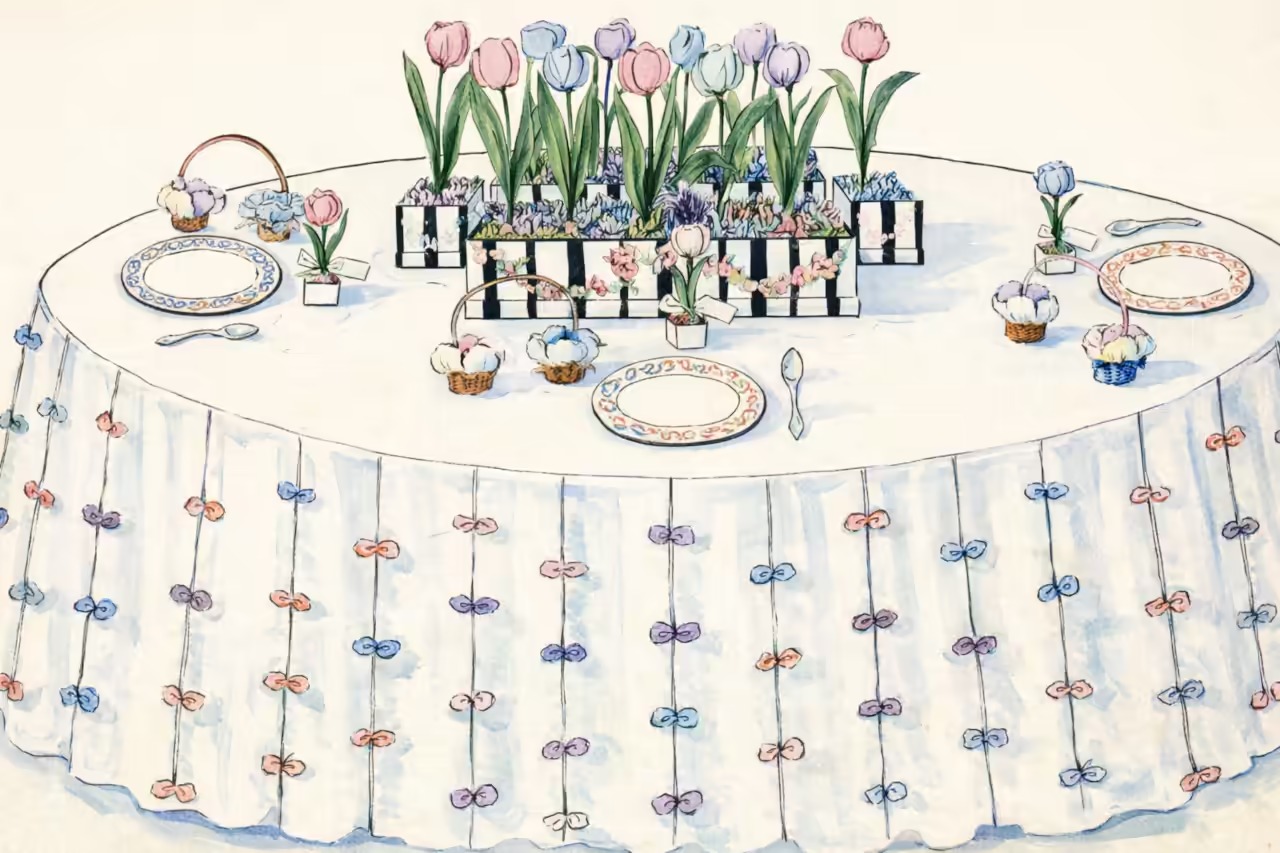
Beautiful 1920s style table arrangement with Barometer flowers

The Table as a Weather Instrument

What appears at first to be a decorative novelty reveals a more interesting function. The barometer flowers described in Dennison’s Gala Book transform the dining table into a responsive surface. Colour is no longer fixed. It changes with the atmosphere.

In this arrangement, decoration becomes a form of indication. The table does not simply display flowers. It reflects conditions beyond the room. Weather, material, and social setting are brought together in a single composition.

Long before electronic sensors and smart materials, this example shows how simple chemistry and craft could create a subtle interaction between environment and design. The result is a small but striking example of how uncertainty itself was designed into the experience of the table.

How the Colour Change Worked

The exact formula is not provided in this page, but colour-changing papers of this type typically relied on chemical indicators sensitive to moisture in the air. As humidity shifted, the treated crepe paper would change colour, producing the effect described as a domestic “barometer.”

Exhibit Notes

This article preserves a playful and beautiful guide to arranging an Easter table in early 20th century style. The original page has charm enough on its own, yet the recreated illustrations allow the composition to bloom more fully on the modern webpage. I find the subject delightful. It is easy to imagine such an arrangement bringing brightness, novelty, and a little theatre to a spring table. I should not be surprised if I one day attempted a version of it myself. Until then, I remain inspired by its sense of occasion.

I must also confess that I was not familiar with barometer flowers before encountering this page. In the context of this article, barometer flowers are decorative crepe paper flowers treated with a chemical solution so that they change colour according to atmospheric conditions. The idea is both practical and whimsical. These are not merely ornaments. They are ornaments made to react, turning the table itself into a small weather display.

That detail led me to think about how such an arrangement would have been prepared in 1922, when Dennison’s Gala Book was published. One can picture an attentive home organiser assembling boxes, ribbons, paper flowers, and place cards in anticipation of guests, treating the table not simply as a surface for dining but as a stage for hospitality. It is equally pleasant to imagine that such a hostess, or host, might also have had access to Guide To Accomplishments In Conversation (1879), and perhaps reread The Art of Conversation at Dinner Parties before the event. The visual setting and the social setting belong together. A thoughtfully arranged table invites conversation just as surely as conversation animates the table.

In that spirit, I offer a few conversation starters suited to the theme of “April Showers Bring May Flowers”:

For me, this artefact captures a lovely intersection of craft, hospitality, and imagination. It reminds us that even a modest luncheon table could be treated as an expression of taste, anticipation, and delight.

Notes & Memoranda

Glossary

Barometer flowers
Decorative crepe paper flowers treated with a chemical solution so they change colour according to atmospheric conditions, used here as both ornament and novelty indicator of the weather.
Crepe paper
A textured paper with a crinkled surface that can be stretched and shaped, used in this article to construct artificial flowers capable of holding form and absorbing chemical treatments.
Passe-partout binding
A decorative paper or card edging material produced by Dennison, used here as black striping to trim and frame the flower boxes on the table.
Jonquils
A type of narcissus flower with small, fragrant blooms, mentioned as a common real flower alternative that the hostess might choose not to use in favour of paper decorations.
Narcissus
A genus of spring-blooming flowers (including daffodils), referenced as traditional Easter table flowers contrasted with the more inventive paper alternatives.
Boutonniere bouquets
Small decorative flower arrangements, typically worn or used as accents, here adapted as miniature paper bouquets in pastel shades for table decoration.
Nut cups
Small decorative containers placed at each setting to hold nuts or sweets, described here as two-colour paper constructions contributing to the overall table design.
Place card flower
A decorative flower used to mark a guest’s seat, combining a name card with a small crafted bloom, in this case incorporating the colour-changing barometer effect.
Vari-coloured blossoms
Multi-coloured decorative flowers used in strings around the table edge, reinforcing the shifting colour theme of pink, blue, and lavender described in the article.
Barometer liquid
The unspecified chemical solution applied to the crepe paper flowers, responsible for their colour-changing properties, offered by Dennison as a proprietary formula available on request.

Frequently asked questions

What are barometer flowers?

Barometer flowers were decorative paper flowers made to change colour under different atmospheric conditions. In Dennison’s 1922 Gala Book, they were presented as an Easter table decoration whose colours shifted with the weather.

How did barometer flowers change colour?

The flowers were made from white crepe paper treated with a chemical solution. According to the booklet, this treatment caused the paper to turn blue in fair weather, pink in stormy weather, and lavender in unsettled conditions.

Why were paper flowers used instead of real flowers?

Paper flowers allowed decorators to create controlled shapes, colours, and themed arrangements that could be prepared in advance. In this case, they also offered a novelty that real flowers could not: a surface designed to respond visibly to atmospheric change.

Who was Dennison and what was the Gala Book?

Dennison Manufacturing Company was a major American producer of paper goods and decorative materials. The Gala Book was one of its idea books, offering suggestions for seasonal entertaining, handmade decorations, and paper craft projects for occasions such as Easter and May Day.

Could barometer flowers still be made today?

In principle, yes. A modern maker could recreate the visual idea using crepe paper and colour-changing materials, although the original Dennison booklet only states that the formula for the treatment was available on request and does not include it on this page.

15 Victorian Designers, Artists and Makers Worth Knowing

15 Victorian Designers, Artists and Makers Worth Knowing

Should We Continue to Ignore Decorative Panels When Furnishing?

Should We Ignore Decorative Panels?

The Art of Conversation at Dinner Parties

Art of Conversation at Dinner Parties (1897)

Influential Female Figures in the Arts and Crafts Movement

Influential Women
of Arts & Crafts

References

  1. Dennison's Gala Book, Dennison Manufacturing Company (1922) [retrieved 2026-04-15]
  2. The Art of Conversation at Dinner Parties, Guide To Accomplishments In Conversation (1879) [retrieved 2026-04-15]

Disclosure

This article presents a transcription and interpretation of a page from Dennison’s Gala Book (1922), with attention to its decorative, material, and cultural context. Descriptions of barometer flowers and their behaviour are based on the source text and do not include the original chemical formula. The content reflects editorial analysis rather than a definitive account of historical practice. Readers seeking primary context should consult the original publication and related period sources.

Change log

  1. [2026-04-15] Curated item added to phillaneum.com