Decorative Motifs in Arts and Crafts Design
Pattern as the Grammar of Decoration
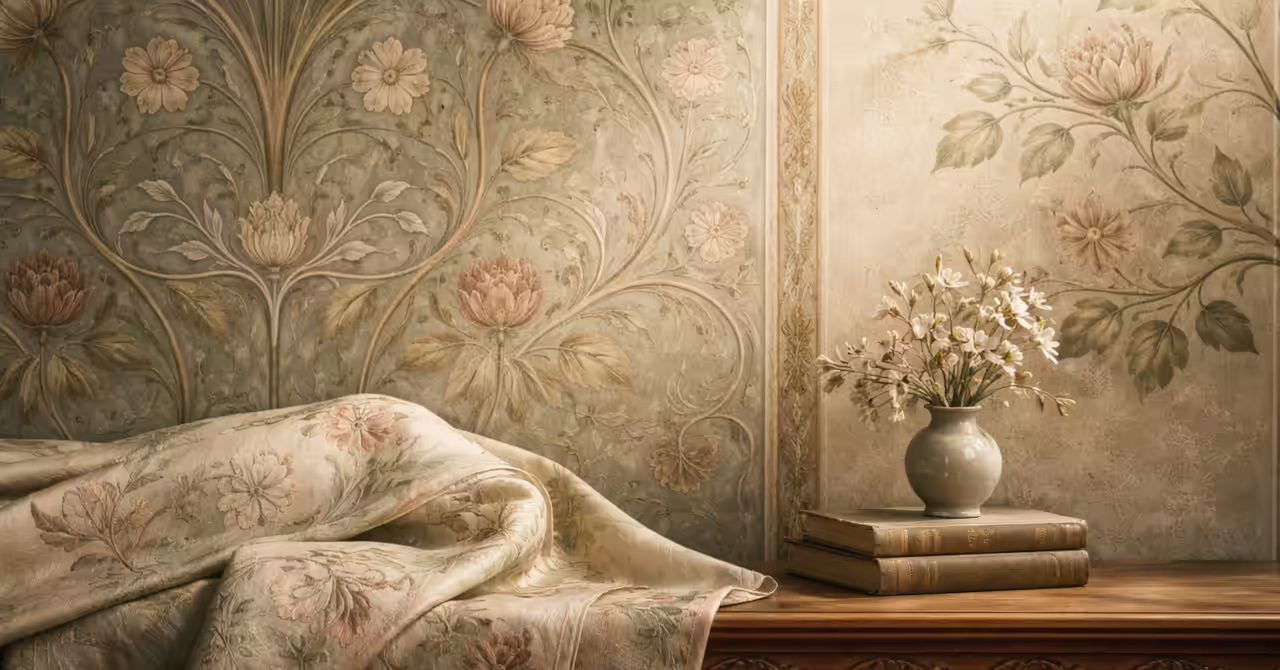
In Arts and Crafts design, decorative motifs linked close observation of nature with the ordered surfaces of the home. A leaf, a flower head, or a curling vine was rarely used as a mere embellishment. It became the unit from which a wider pattern could grow. At the same time, grids, bands, and repeating intervals gave such motifs steadiness and measure. The relationship between natural form and formal order shaped much of the movement’s visual language. It can be seen in embroidery, woven textiles, wallpapers, wood panels, and other interior surfaces produced in the late nineteenth and early twentieth centuries.
Embroidery provides one of the clearest views of this process. Because each stitch must follow the logic of the motif, the relationship between form and construction becomes immediately visible. This is explored in detail in Embroidery in the Arts and Crafts Movement, where motif and technique meet in practice.
This relationship is especially useful when reading period design sources. Motifs appear again and again, yet they are rarely identical from one medium to another. A rose in wallpaper does not behave in quite the same way as a rose in crewel work. A vine carved into timber must obey different limits from one printed on cloth. Even so, the underlying design thinking remains recognisable. The motif carries memory from one craft to the next. It lets the eye identify a common vocabulary across materials that otherwise seem very different.
Seen in this way, decorative motifs were central to composition. They organised repetition, framed spaces, and moderated proportion. They helped artisans turn walls, furnishings, and textiles into related parts of a room rather than isolated displays of ornament.
Motifs Joined Nature to Surface Design
The Arts and Crafts movement valued handwork, but it also valued discipline in design. Decorative motifs sat at the meeting point of these concerns. Natural forms provided the starting material, while abstraction made them suitable for repeated use. Designers did not attempt to reproduce a field, hedge, or garden with literal accuracy. Instead, they reduced observed forms to clear shapes that could be repeated, mirrored, scaled, and contained within a border or all-over pattern.
That reduction was the key relationship. Nature supplied character. Design supplied order. A stem might be straightened, a petal simplified, or a cluster of leaves turned into a balanced unit that could recur across a surface. In embroidery this made stitching practical and visually coherent. In wallpaper it allowed for rhythmic repeat. In woodwork or painted interiors it gave ornament a structural calm that suited domestic space.
Motifs therefore did more than decorate an object. They taught the surface how to behave. They established where the eye would rest, how movement would travel across the pattern, and how dense or quiet a field of decoration should feel. In many Arts and Crafts interiors, the success of a design depended less on the novelty of any single motif than on the way motifs were arranged to create continuity.
How stylised forms created rhythm and order
The mechanism is easiest to see in repeated pattern. A stylised motif functions like a small design engine. Once shaped into a usable unit, it can be turned, paired, spaced, or linked to another unit. This produces rhythm. A row of leaves can guide the eye along a border. Alternating flower heads can stabilise a broad textile field. A climbing vine can pull vertical movement into a curtain, panel, or embroidered hanging.
Geometric structure made this possible. Even the most organic Arts and Crafts patterns often rest on hidden scaffolds. A trellis arrangement, a diamond repeat, a vertical stripe, or a measured border gives the motif its place. Without that support, natural forms can become loose and crowded. With it, they achieve balance. The pattern feels alive but never unruly.
This process also encouraged consistency across the decorative arts. A designer could adapt a motif from wallpaper to embroidery because the motif had already been clarified into a pattern unit. Its details might change according to medium, yet its role remained stable. It could fill, frame, separate, or connect. Through repetition and spacing, motifs became tools for controlling proportion as much as vehicles for visual pleasure.
Why Arts and Crafts ornament feels distinct
Arts and Crafts motifs differ from heavier Victorian ornament in both temper and purpose. Much earlier decoration aimed at richness through accumulation. Surfaces could be crowded with detail, layered with symbolism, or weighted with historical quotation. By contrast, Arts and Crafts pattern often sought a quieter authority. Its motifs are usually recognisable, but they are pared back. Their strength lies in shape, interval, and relation rather than sheer abundance.
This distinction has important implications for how we read these interiors now. The motifs may appear modest at first glance, yet they do substantial compositional work. A repeated carnation or pomegranate does not simply add charm. It sets tempo. A sequence of stems can make a room feel taller. A clustered floral repeat can warm a textile without overwhelming adjoining surfaces. Because the motifs are disciplined, they allow different elements in a room to coexist.
That restraint also helps explain the movement’s lasting appeal. The designs feel observed rather than copied from life, and ordered rather than mechanically rigid. They preserve a sense of living growth while still respecting the flatness of cloth, paper, plaster, or timber. The result is ornament that feels integrated with making, not applied after the fact.
Reading a shared vocabulary across media
Once this design logic is recognised, early twentieth-century examples begin to speak to one another more clearly. A motif seen in embroidery can illuminate one found in wallpaper. A border in a woven textile may echo the same balance of stem and interval used in painted furniture or carved detail. The media differ, but the vocabulary remains shared. This is one of the most revealing ways to study Arts and Crafts decoration.
For the reader or collector, this offers a practical method. Instead of asking only what a motif depicts, it is useful to ask what it does. Does it fill a ground evenly, direct movement, mark an edge, or break a large surface into measured parts? Does the design rely on mirror symmetry, offset repeat, or vertical climb? Such questions move the motif from the category of ornament into the category of composition.
They also open a path to related subjects. Decorative motifs lead naturally into discussions of textile structure, embroidery practice, wallpaper design, and the furnishing of the Arts and Crafts home as a coordinated interior. To follow that path is to see decoration not as a collection of isolated pretty details, but as a disciplined language of form carried from one craft to another.
When these motifs are returned to their setting, their role becomes even clearer. They are not abstract designs but working elements within the furnished interior, shaping how textiles relate to furniture, light, and space, a relationship considered in Textiles in the Arts and Crafts Home.
From Motif to the Furnished Interior
Decorative motifs in Arts and Crafts design were most effective when they joined natural observation to compositional order. Leaves, flowers, and vines carried the memory of the living world, while their stylised forms allowed artisans to build rhythm, repetition, and proportion into domestic surfaces. Through this shared vocabulary, embroidery, textiles, wallpaper, and woodwork were drawn into a coherent whole.
This relationship can be read as a continuous chain of making. The motif gives structure to pattern. The textile carries that pattern into material form. The interior gathers these materials into a lived composition. To follow one element closely is to be led, almost inevitably, to the others.
From here, the next step is to look beyond the motif itself and consider how these patterned surfaces work together within the room. In doing so, the Arts and Crafts interior comes into view not as a backdrop for ornament, but as a setting in which design, material, and daily life are brought into deliberate relation.
Author's Notes
Notes & Memoranda
Glossary
- Decorative motif
- A repeated visual element, often based on natural forms, used to structure and organise pattern across surfaces such as textiles, wallpaper, and woodwork.
- Stylisation
- The process of simplifying and refining natural forms into clear, repeatable shapes suitable for pattern design and decorative application.
- Pattern repeat
- The method by which a motif is repeated across a surface at regular intervals, creating rhythm and continuity in textiles, wallpaper, and other decorative fields.
- Geometric structure
- An underlying framework such as a grid, stripe, or trellis that supports the placement and spacing of motifs within a balanced design.
- Visual rhythm
- The sense of movement created by the repetition and spacing of motifs, guiding the viewer’s eye across a decorated surface in a controlled and harmonious way.
Frequently asked questions
What defines a decorative motif in Arts and Crafts design?
A decorative motif is a repeated visual unit, often derived from natural forms such as leaves or flowers, that has been simplified and structured for use in pattern. It serves as both ornament and a compositional tool.
Why are natural forms so common in Arts and Crafts motifs?
Natural forms were valued for their honesty and clarity. Designers observed plants and organic growth, then refined these shapes into stylised forms that could be repeated and adapted across different decorative surfaces.
How were motifs adapted across different media like embroidery and wallpaper?
Motifs were adjusted to suit the material and method of production. In embroidery, they followed stitch logic and thread movement, while in wallpaper they were arranged for seamless repetition. The underlying structure remained consistent.
How do motifs contribute to balance and proportion in a design?
Motifs guide spacing, repetition, and rhythm. By controlling how a pattern repeats and where the eye travels, they help establish visual balance and proportion across a surface or within a room.
Further Reading…
Disclosure
This article presents an interpretive reading of decorative motifs in Arts and Crafts design, with attention to their use across textiles, wallpaper, woodwork, and interior surfaces. It reflects editorial analysis rather than a definitive account of historical practice. Readers seeking primary context should consult period sources and surviving examples.