Reimagining Amilcar as a Modern Car Brand
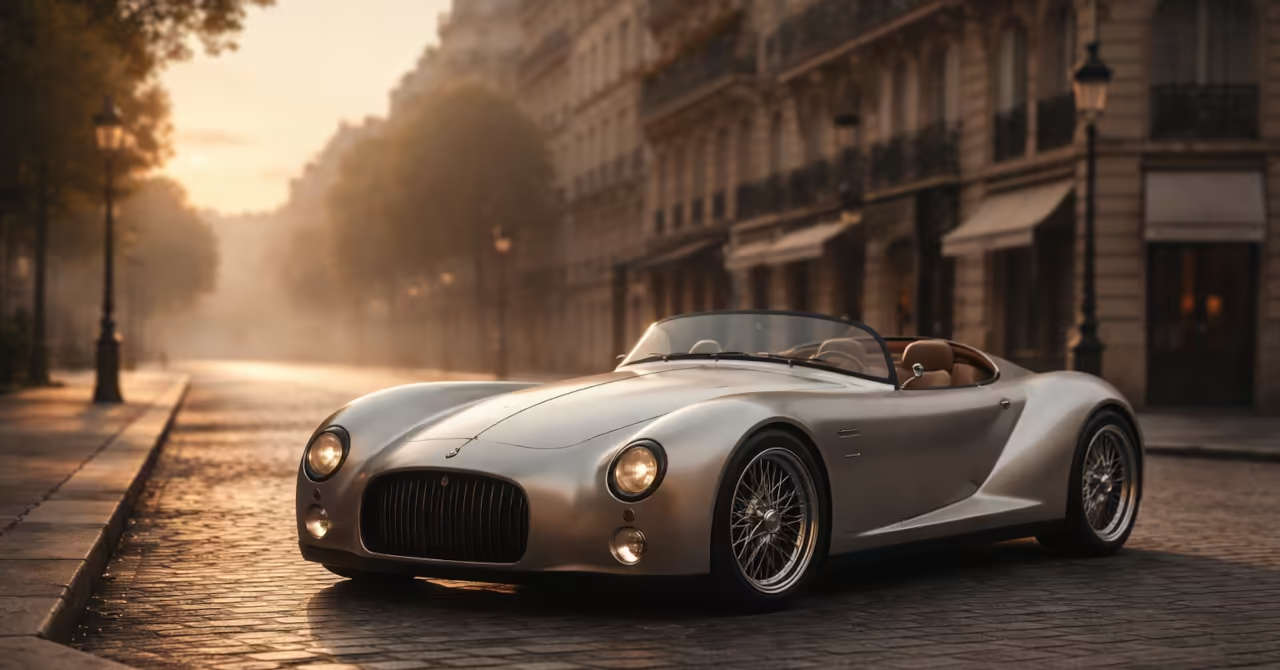
Reviving a Marque Without Copying Its Shape
Amilcar belongs to two ideas at once. It belongs to the world of vintage French motoring, with its narrow tyres, polished instruments, and fine Parisian restraint. It also belongs to a larger idea that has not gone away, which is the belief that a machine can express taste as clearly as it delivers motion. That relationship is the real subject here. If Amilcar were to return as a modern brand, the task would not be to redraw an old bonnet or revive a period badge. It would be to translate a design philosophy from one age into another.
The original Amilcars were never only about speed. They were about proportion, control, and social poise. The cars were small, but they did not feel mean. They were sporting, but they did not need to shout. Even the more purposeful models carried themselves with a certain discipline, as seen in the Amilcar Course 6 Cylindres 2 Places Sports Car, where performance and restraint were held in careful balance. That quality matters now because the modern car market is rich in performance yet poor in character. Many vehicles are fast. Fewer feel shaped by a coherent cultural idea. A revived Amilcar would need to answer that absence.
Lightness Must Become the Brand’s True Inheritance
The relationship between old Amilcar and new mobility is not mechanical continuity. It is continuity of intent. The historic marque stood for lightweight elegance, coachbuilt identity, and gentlemanly performance. A modern revival would need to preserve those values while changing almost every means by which they are delivered. In that sense, the challenge is less like restoration and more like translation. One must keep the meaning while allowing the language to change.
Most heritage revivals fail because they copy surfaces. They reproduce grilles, lamps, and badges, then hope memory will do the rest. That approach is shallow. Amilcar deserves better. Its strength was never a single visual cue. Its strength lay in the union of modest scale, refined engineering, and social grace. The better question is not, “What would a new Amilcar look like?” The better question is, “What would a modern vehicle feel like if it were shaped by the same instincts?” The answer would be something restrained, finely judged, and deeply aware of its user.
From mechanical lightness to design restraint
The first thing to preserve is lightness, though the meaning must widen. In the 1920s, lightness meant compact engineering, responsive handling, and the absence of unnecessary bulk. In a modern vehicle, especially an electric one, true lightness in kilograms is harder to achieve. Batteries are heavy. Safety systems add weight. Digital interfaces add complexity. Yet design restraint is still possible. A modern Amilcar could be light in visual mass, light in touch, and light in cognitive load.
That would mean a small footprint, disciplined proportions, and an interior that avoids the current fashion for oversized screens and restless surfaces. Controls should be simple and deliberate. Materials should feel honest. Performance should be lively rather than excessive. The car should invite confidence, not domination. One can imagine a compact electric roadster, or perhaps an elegant two-plus-two city grand tourer, built around the idea that agility and calm are more desirable than brute acceleration. The mechanism, then, is not nostalgia. It is restraint applied through contemporary design, interface choices, and human-scale performance.
Coachbuilding cannot return, but identity still can
The second question is what must change. Amilcar was born in an era when coachbuilders shaped identity panel by panel. That world no longer exists. Modern manufacturing does not support artisanal bodies at scale. Platforms, software, and regulation now define the industry. If Amilcar were to return, its individuality would need to be expressed through different means.
This is not a loss if handled with care. The modern equivalent of coachbuilding is curated customisation. Exterior finishes, trim selections, interior materials, and interface themes can be composed with intent. The result should feel deliberate, not optional. Limited production series could also carry distinct design moods, echoing how Parisian ateliers once gave each chassis its own character. The direction is clear. A revived Amilcar should not compete on volume or raw output. It should compete on coherence, tactility, and the sense that the object has been shaped for a specific kind of owner.
That owner remains central. The original gentleman driver valued control, discretion, and form. He was not defined by wealth alone. A modern equivalent need not follow the same social profile, yet the principle still holds. The buyer should feel recognised as a person of taste, not as a collector of specifications. This is where Amilcar could stand apart from the louder language of contemporary performance branding.
What a modern Amilcar could become in practice
If one extends the argument into application, the most convincing path is a small premium mobility brand with a narrow and carefully edited range. The halo model would be a compact electric sporting car. It would not chase the most extreme range or the most absurd power figure. Instead it would offer precise steering, elegant packaging, and an interior with the atmosphere of a private salon. There should be room for beauty in the cabin. Good cloth, fine leather, brushed metal, perhaps even carefully voiced sound design in place of old mechanical music.
A second model could be an urban grand routier. Not an SUV, and certainly not a blunt object. Something slender, practical, and civilised. The emphasis would be on city grace, weekend touring, and visual distinction. Ownership could include curated drives, design events, and membership experiences that recall the social world once suggested by the showroom. Even the retail environment should matter. An Amilcar studio ought to feel more like a gallery than a dealership.
Such a brand would never aim to dominate the road. It would aim to recover a lost balance between engineering and manners. That is a rare proposition now. It is also one that fits the old marque unusually well.
The Next Step Lies in Philosophy, Not Styling
To reimagine Amilcar as a modern brand is not to revive the past in amber. It is to ask which values remain alive once the machinery has changed. Lightweight elegance, personal identity, and civilised performance still have force. They may even be more valuable now because so much of the market has drifted toward excess. If Amilcar has a future in the imagination, it lies there.
The next useful step is to place this idea beside the existing Amilcar lineage. Read it against the 1927 showroom world, where models expressed temperament, and against the Pégase, where coachbuilding turned motion into style. That is where the continuity becomes clear. The brand should not be revived by copying old forms. It should be revived by remembering what those forms were trying to achieve.
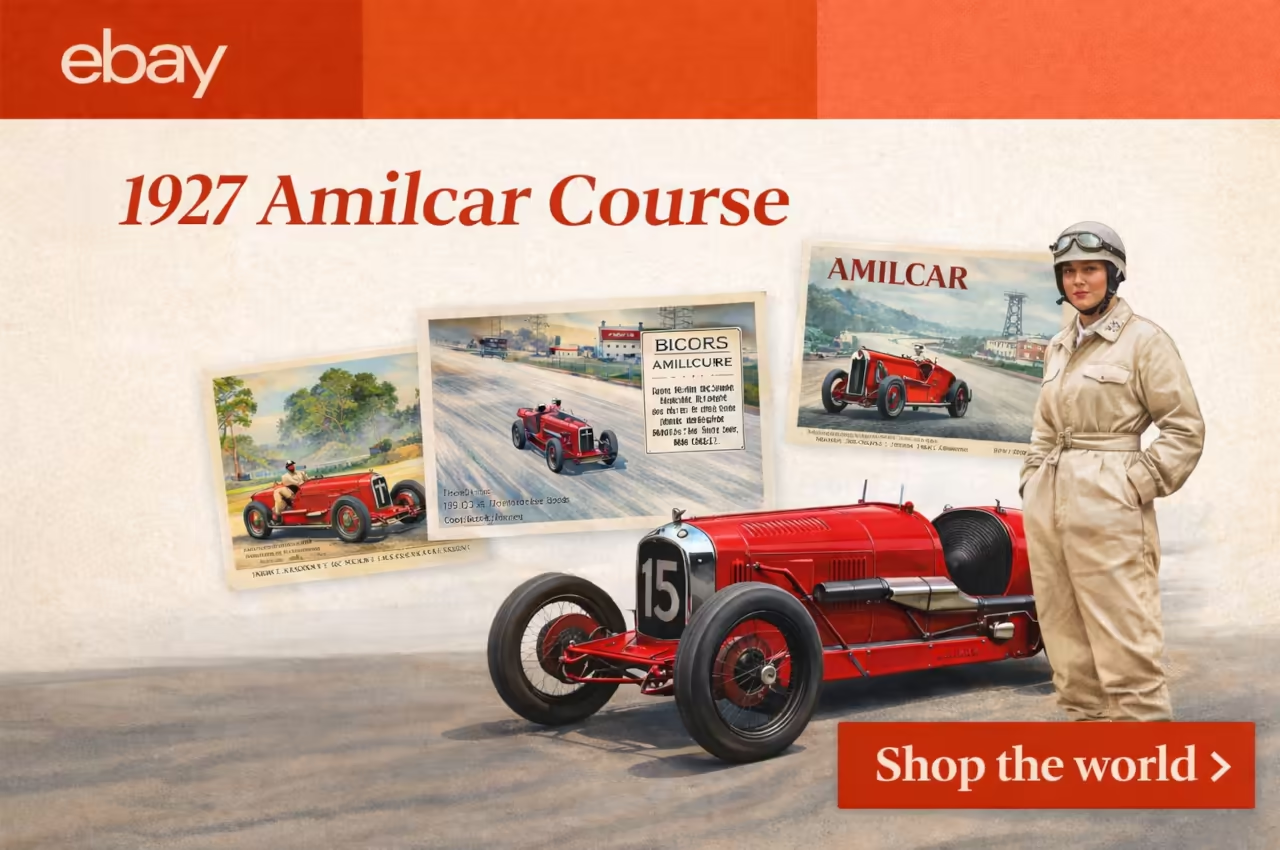
Collector market snapshot: Original Amilcar material surfaces across a surprisingly broad range of artefacts, from period brochures and factory literature to enamel badges, model cars, and surviving mechanical components. Pre-war publications—particularly showroom catalogues and coachbuilder references—remain the most desirable, offering direct insight into how these machines were presented to their original clientele. Smaller items such as grille badges and scale models appear more frequently, providing accessible entry points for enthusiasts. Complete vehicles and major parts are rarer and tend to circulate within specialist circles, where provenance and condition significantly influence value. For most collectors, printed material and memorabilia offer the clearest and most attainable connection to the Amilcar legacy.
Notes & Memoranda
Glossary
- Coachbuilding
- In this article, coachbuilding refers to the historical practice of constructing bespoke car bodies on a supplied chassis, often by specialised ateliers, resulting in unique designs that expressed both craftsmanship and owner identity.
- Lightweight philosophy
- The term lightweight philosophy describes an engineering and design approach that prioritises efficiency, agility, and restraint over sheer power or size, aiming for a balanced and responsive driving experience.
- Gentleman driver
- A gentleman driver is a non-professional motorist who participates in driving or racing as a pursuit of refinement and personal enjoyment, rather than as a career or purely competitive endeavour.
- Design restraint
- Design restraint refers to the deliberate limitation of visual and functional elements to achieve clarity, elegance, and usability, avoiding unnecessary complexity or excess.
- Configurable platform
- A configurable platform is a modern vehicle architecture that allows variations in design, features, and finishes through modular components, enabling a degree of personalisation without bespoke manufacturing.
- Electric vehicle (EV)
- An electric vehicle is powered by electric motors using energy stored in batteries, replacing traditional internal combustion engines and introducing new design and performance considerations.
- Automotive salon
- In this article, an automotive salon refers to an interior design concept that emphasises comfort, conversation, and aesthetic harmony, drawing from the cultural idea of a refined social space.
- Experience economy
- The experience economy describes a market approach where value is created through memorable and curated experiences, rather than solely through ownership of physical products.
- Human-scale performance
- Human-scale performance refers to vehicle capabilities that feel usable, engaging, and appropriate to real-world conditions, rather than extreme or excessive on-paper figures.
- Heritage revival
- Heritage revival is the process of reintroducing a historical brand or design language in a modern context, often requiring reinterpretation of original values rather than direct replication of past forms.
Frequently asked questions
What made Amilcar different from other vintage car brands?
Amilcar stood apart from many vintage car brands by combining lightness, refined engineering, and social elegance in a single identity. Rather than chasing sheer size or brute power, the marque developed small sporting cars that felt agile, disciplined, and distinctly French in character. Its appeal often lay as much in proportion, coachbuilt style, and cultural tone as in performance itself.
Why is Amilcar associated with lightweight performance?
Amilcar is associated with lightweight performance because its cars were designed around agility, responsiveness, and efficient use of modest engine capacity. In the 1920s, this meant compact chassis design, restrained proportions, and an emphasis on lively handling rather than raw horsepower alone. The result was a form of performance that felt precise and usable, not merely forceful.
What is meant by a “gentleman driver” in the context of Amilcar?
In the context of Amilcar, a gentleman driver is a motorist who values skill, taste, and personal enjoyment over professional competition or public bravado. The term suggests a driver who appreciates engineering quality and sporting character, yet also cares about manners, proportion, and social poise. It reflects the idea that motoring could be both spirited and civilised.
How does coachbuilding compare to modern customisation?
Coachbuilding and modern customisation both shape vehicle identity, but they do so in very different ways. Traditional coachbuilding involved specialised artisans creating bespoke bodies on a chassis, often producing unique forms with strong personal character. Modern customisation usually works within modular manufacturing systems, offering selected finishes, trims, and feature combinations rather than fully individual body construction. One is handcrafted individuality, while the other is curated variation at scale.
Further Reading…



References
- Amilcar Pégase 1936 — Parisian Coachbuilders & the Art of Motion, phillaneum.com [retrieved 2026-04-03]
- Topic: Amilcar, philreichert.org [retrieved 2025-12-13]
Disclosure
This article presents an interpretive exploration of how the Amilcar marque could be reimagined in a modern context, drawing on historical references and editorial perspective. Any references to contemporary design or mobility concepts are speculative in nature. Some links may be affiliate references; a small commission may be received at no additional cost. Readers seeking authoritative historical details should consult primary sources and specialist automotive archives.