5 inventors who turned patents into fortunes
·Revised
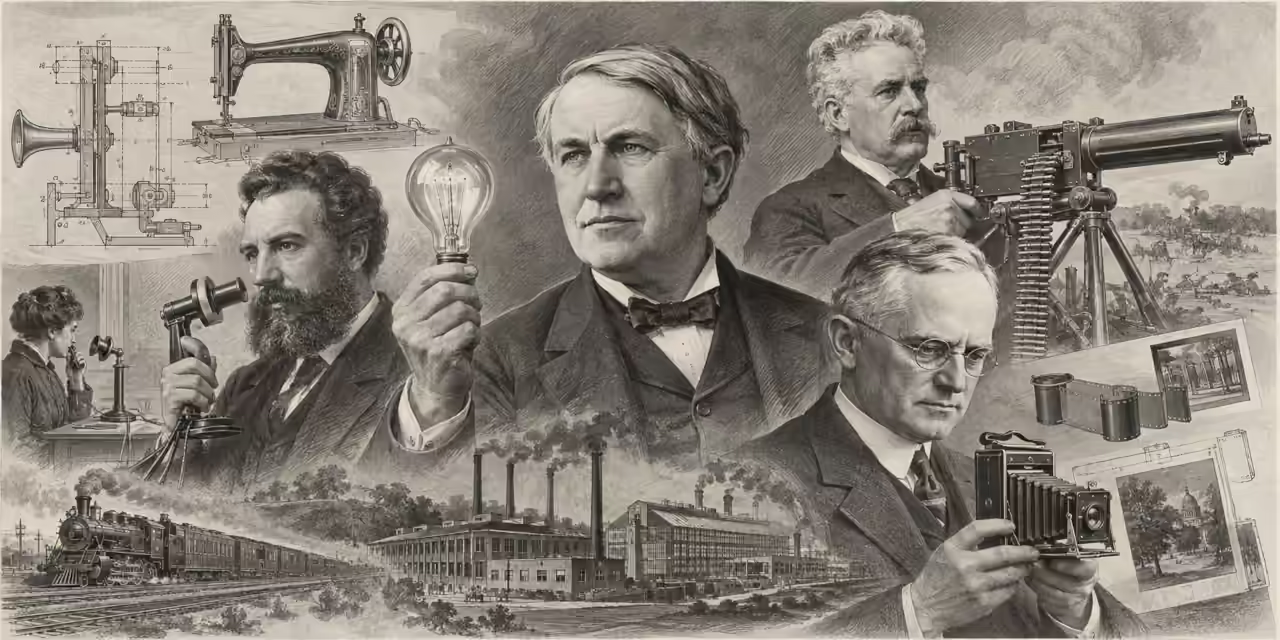
A patent is not a cheque. It is a temporary legal right: the inventor discloses an invention and, in return, may stop others from making, using or selling it without permission. The difficult part begins afterwards. Someone must manufacture the device, find customers, defend the claims in court or persuade an established company to pay for a licence.
That distinction matters when looking at how an invention moves from patent to product. An ingenious machine might deserve a patent and still make its inventor almost nothing. The inventors below solved the second problem as well: turning protected mechanisms into businesses, licences, infrastructure and repeatable products.
Their fortunes came through very different arrangements: a sewing-machine royalty collected from other manufacturers, a telephone company built around a patent, laboratories and companies organised around families of inventions, licensing deals for weapons and electrical equipment, and a carefully designed photographic service. In each case, the valuable object was not simply an idea on paper. It was a mechanism that could be repeated, sold and protected.
1. Elias Howe: the royalty machine
Elias Howe's 1846 sewing-machine patent covered a particular lockstitch arrangement: two threads interlocked by a needle and shuttle. Howe did not invent every part of the sewing machine, and his early machine was not immediately a commercial success. The important point was narrower and more technical. His patent covered a method that later manufacturers found difficult to avoid when building a practical machine.
Howe spent years in poverty and in litigation before American courts recognised his claim against manufacturers including Isaac Singer. Once the industry began licensing the essential features, the patent became a toll gate. The Sewing Machine Combination formed in 1856 to reduce the destructive patent disputes, and Howe received a royalty on machines made by participating manufacturers. Contemporary accounts and later historical summaries place his receipts from the patent at more than one million dollars, with some estimates exceeding two million dollars between 1856 and the patent's expiry.
What changed: Howe no longer needed to manufacture every machine himself. Once his claim was enforceable, other manufacturers could become the source of his income. The machine did not make him rich at first; the enforceable boundary around one crucial mechanism did.
2. Alexander Graham Bell: a patent becomes an infrastructure
Howe showed that a patent could become a toll gate. Alexander Graham Bell's telephone demonstrated something larger: a protected invention could become the foundation of an entire network.
Bell's telephone patent, granted in the United States on March 7, 1876, did not merely protect a handsome instrument. It helped establish control over a complete system of transmitters, receivers, wires, exchanges and subscribers. A telephone was useful only when connected to other telephones, so the commercial advantage grew as the network grew.
Bell and his partners founded the Bell Telephone Company in 1877. The company licensed equipment, constructed exchanges and defended Bell's patent against rival claims. Bell's personal wealth therefore came through a combination of patent rights, company ownership and the expanding value of a communications network, rather than from selling individual telephone handsets at a large margin.
What changed: the patented mechanism became more valuable as a commercial system grew around it. The patent provided the legal foundation, but the fortune came from organising a service that could connect thousands of reproductions of the invention together.
3. Thomas Edison: patents arranged as a working laboratory
Bell built a network around an invention. Thomas Edison went another step and organised invention itself as an industrial process.
Edison is often reduced to the phrase “inventor of the light bulb”, but his commercial method was broader. He built teams, laboratories and manufacturing companies around groups of related patents. The electric lamp was only one part of a system that also required generators, wiring, switches, meters and a dependable supply of electricity.
Edison accumulated more than a thousand United States patents during his career, covering telegraphy, sound recording, electric lighting, batteries and motion pictures. Some inventions failed commercially. Others became valuable because Edison and his business partners could combine them into products and infrastructure. The Edison Electric Light Company, founded in 1878, turned laboratory work on lighting into an industrial venture.
What changed: the commercial unit was no longer necessarily one inventor and one patent. Edison assembled skilled workers, capital, experiments, legal protection, manufacturing and routes to market around groups of inventions. His wealth consequently came through several channels—company ownership, investment, licensing and the commercial use of patents.
4. Hiram Maxim: the mechanism that paid twice
Edison's model required laboratories, factories and infrastructure. Hiram Maxim's career demonstrates another route: invent a mechanism whose advantage could be demonstrated immediately to a small number of very large customers.
Maxim became wealthy from more than one class of invention. Before his armaments work, he held patents connected with electrical lighting. His most famous mechanism was the recoil-operated Maxim gun, developed in the 1880s. When the gun fired, recoil energy operated the action, allowing the weapon to load and fire repeatedly without a hand-operated cycle.
That engineering decision mattered commercially. A manually operated weapon depended on the operator's arm for each shot; Maxim's design used the energy already present in the firing process. The result was a technically distinctive product that could be demonstrated, licensed and supplied to governments and arms manufacturers.
A report reprinted from the 1888 Scientific American described Maxim as having received $850,000 in England for his quick-firing gun and about $100,000 earlier for electrical-lighting patents. Those are period figures, not modern equivalents, but they show the scale of the transactions.
What changed: Maxim did not need millions of individual customers. A mechanism with obvious institutional value could produce enormous transactions through licensing and sales to organisations willing to pay for it.
5. George Eastman: the patent inside the consumer product
Maxim could sell an expensive mechanism to governments and manufacturers. George Eastman approached the opposite end of the market: make a technically difficult process simple enough for ordinary people to use.
Eastman did not invent photography. His achievement was to remove some of its most troublesome mechanical and chemical obstacles. Early photography required bulky glass plates, careful preparation and specialist handling. Eastman developed machinery and processes for coating photographic plates, then helped create a company that could manufacture photographic materials consistently.
His patents formed part of a larger commercial system. The Kodak camera, introduced in 1888, paired a simple box camera with roll film that could be returned for processing. The customer did not need to operate a darkroom; the company supplied the consumable film and performed the complicated chemical work.
What changed: Eastman made the difficult technology disappear behind a simple consumer experience. His fortune came less from collecting a fee every time somebody took a photograph than from owning and expanding a business built on patented machinery, photographic materials, processing and brand recognition. His later gifts of company stock and large philanthropic donations provide visible evidence of the wealth created by that system.
Patent reality… A patent can protect a mechanism, but it cannot manufacture, advertise or distribute the finished product. Howe turned protection into royalties; Bell into a network; Edison into an industrial system; Maxim into major licensing transactions; and Eastman into a consumer service. The fortune appeared when legal protection became part of a commercial machine.
The part the patent cannot do
Put the five cases beside one another and there is no single formula. Howe was paid when other people manufactured machines. Bell's invention gained value as a network expanded. Edison built organisations capable of producing and commercialising inventions repeatedly. Maxim sold technically distinctive mechanisms to institutional customers. Eastman made a complicated technology accessible to a mass consumer market.
These cases are not a recipe for becoming rich. Patents expire, lawsuits consume money, competing inventions appear and many technically excellent devices never find a paying market. Even a successful inventor may become wealthy from company shares or licensing negotiations rather than from the patent document alone.
That is what makes historical mechanisms worth studying. The visible object—a needle, a telephone receiver, a lamp, a gun or a camera—is only the centre of a much larger arrangement of materials, manufacturing decisions, contracts and habits. The patent protected the mechanism. The fortune followed the arrangement.
For a wider warning about the practical hazards surrounding invention, see our guide to inventor traps.
From the Curator's Workshop
Phillaneum's Cabinet of Curious Vintage Mechanisms design gathers the visual language of old machines, patents and illustrated technical catalogues into a monochrome vintage-style graphic. It is a T-shirt rather than a historical artefact, but it is intended as a wearable extension of the same curiosity: the pleasure of seeing how ingenious, awkward and consequential mechanisms can be.

Author's Notes
My shortlist of five inventors became a list of ten almost immediately. Lawrence Hargrave, Joseph Swan and Nikola Tesla were among the names competing for space, alongside inventors whose contributions were less famous but whose stories were no less remarkable. Some patented extraordinary machines, some improved somebody else's invention, some fought over priority, sold their rights, founded companies or watched other people make far more money from an idea than they did. The shortlist grew considerably faster than the article could accommodate.
That also made the word inventor rather less tidy than I had expected. Several familiar inventions emerged through successive improvements made by different people, sometimes accompanied by overlapping patent claims and competing accounts of who had done what first. Deciding who belonged here therefore meant looking beyond the convenient claim that somebody simply “invented” a famous object. I became much more interested in identifying the particular contribution an inventor could protect, and then tracing what happened after that protection was obtained.
Hargrave was one of the more difficult names to leave out, particularly for an Australian publication. His experiments with flight and the box kite made him a fascinating candidate, but his story led in a different direction from the five I eventually selected. Swan presented another problem: once incandescent lighting enters the discussion, the apparently simple question of who invented the electric light rapidly becomes a story of competing designs, improvements and claims. Narrowing the field became less an attempt to rank history's greatest inventors than an exercise in choosing five contrasting stories that revealed different things about invention, patents and what happened afterwards.
One of the pleasures of researching the article was following the inventors away from the objects for which they are now famous. Hiram Maxim's work in electrical lighting before the Maxim gun is a good example, while Eastman's story becomes considerably more interesting once the camera is placed back among photographic materials, manufacturing machinery and processing. Again and again, the familiar invention turned out to be only the most visible fragment of a much larger working life.
That is probably the research thread I would most like to return to. There is another article hiding behind this one: not simply about what these people invented, but about all the other things they were experimenting with, patenting, improving, abandoning and trying to make work along the way.
Notes & Memoranda
As is often the case, the subject extends beyond the bounds of a single article. The notes and memoranda below gather together useful definitions, related observations, references, and occasional curiosities discovered along the way.
Glossary
Some of the terms used in this article have specialised, historical or technical meanings. This glossary provides additional context for selected terms and ideas.
- Maxim gun
- An early practical fully automatic machine gun developed and patented by Hiram Maxim in the 1880s; its recoil‑operated mechanism used the energy of each fired cartridge to eject the spent case and chamber the next round, enabling sustained rapid fire. Its widespread adoption by late nineteenth‑ and early twentieth‑century militaries multiplied battlefield firepower, altered tactics in colonial and industrial warfare, and created lucrative arms‑manufacturing and royalty opportunities for its inventor.
- Box kite
- A kite design invented by Lawrence Hargrave consisting of a rectangular, cellular framework of spars and sails rather than a single flat surface; the box structure delivers greater aerodynamic stability and lift than earlier flat kites. Hargrave used the box kite as a controllable lifting platform and experimental model, and its principles of stacked lifting surfaces informed early aeroplane wing and biplane development.
- Tesla coil
- A resonant high‑voltage transformer circuit invented by Nikola Tesla that produces high‑frequency alternating currents and spectacular electrical discharges; it demonstrated resonance, tuning and wireless transmission principles long before radio became widespread. Beyond its showy sparks, the Tesla coil was important historically as an experimental tool for exploring how power and signals might be transmitted without wires.
- Tasimeter
- A fragile laboratory instrument devised by Thomas Edison for detecting and measuring very small changes in temperature or radiant heat; it attempted to convert minute thermal effects into a readable mechanical or electrical signal. The tasimeter attracted scientific interest but proved commercially unsuccessful and was superseded by more reliable thermometric and electrical detectors.
- Licensing agreement
- A legal contract in which a patent owner grants another party permission to use, make or sell the patented invention under specified conditions in return for payment (typically upfront fees, ongoing royalties, or both). Licensing lets inventors monetise technology without building production capacity themselves, and agreements commonly include limits on territory, duration and exclusivity as part of strategic business arrangements.
Frequently asked questions
Curious about something you’ve just read? These frequently asked questions explore some of the key ideas, details and questions surrounding the topic.
How can inventors make money from patents?
Inventors can monetize patents by licensing their technology for upfront fees and royalties, founding companies to manufacture and sell products themselves, or selling patents outright for lump-sum payments.
How long do patent rights usually last?
Patent rights typically last about 20 years from the date of filing and are granted in exchange for disclosing the invention to the public.
Which of the five inventors earned substantial wealth from their patents and which did not?
Thomas Edison and Alexander Graham Bell generated substantial wealth from key patents, Sir Hiram Maxim earned significant income from the Maxim gun, Nikola Tesla struggled financially and often sold patent rights for funding, and Lawrence Hargrave did not prioritize financial gain and did not amass great wealth from his patents.
What was Lawrence Hargrave’s key invention and its significance?
Lawrence Hargrave patented the box kite in 1893, a design that provided greater stability and lift and became a fundamental breakthrough that helped advance aviation and inspired later inventors like the Wright brothers.
Further Reading…

Disclosure
Historical accounts of inventions, patents and personal fortunes can vary between sources, particularly where wealth, royalties and the contribution of individual inventors are concerned. Figures and descriptions in this article should therefore be read as historical estimates and summaries rather than precise financial or legal assessments. Inclusion in this list reflects the article's editorial focus and is not intended as a ranking of the most important or successful inventors.