The Cousins — Edward Burne-Jones (1856)
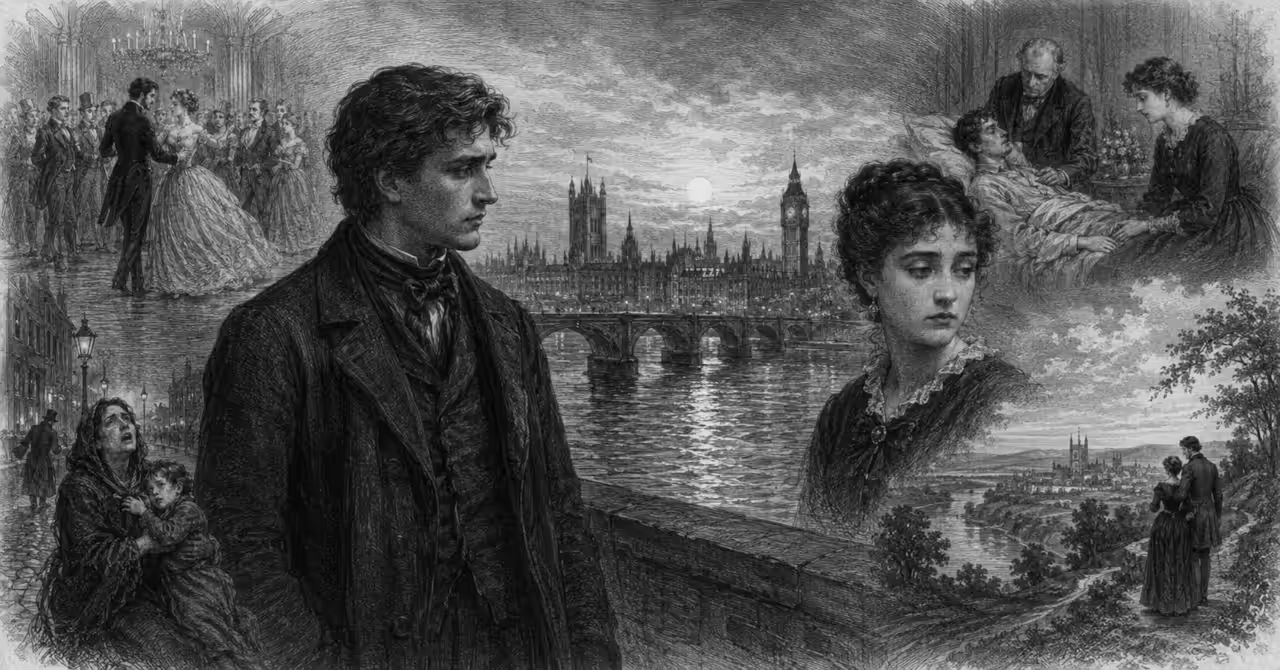
The Cousins.
THE dancers swept merrily by me on that night of Lady Lacy's ball eleven years ago, and fanned me pleasantly as they bounded past to the tune of instruments, and there was nothing in all this to make me peevish, and fretful, and morose; yet I stood aside moodily, taking no part in the dancing, nor the talk—and though I asked myself often how it was that I felt so evil-minded on that night, yet I needed no answer, knowing well the reason, that it was because of my cousin Gertrude, and her troop of flatterers, and because she slighted me openly, putting me to shame before all who knew our betrothal; and because I could not help thinking that somehow her love had grown cold of late.
And some there were who rated me for my gloomy looks, and pestered me with silly questionings, to which I lent little heed or answer. And all the while Gertrude was hidden from me by a ring of satellites, but her silver laugh and jesting troubled me heavily.
"To-morrow," said I, "I will speak to her kindly and firmly, and if it must be so, release her whatever comes to me."
I had fancied moreover that her father's manner was shy and altered to me when I crossed him in the Hall; for he passed by me with unwonted coldness, and left the house immediately.
Two gentlemen were talking in a low tone to one another, close at hand, but, though I moved to be out of overhearing, I had unconsciously caught the substance of their conversation, earnest and grave—some great failures in the north had followed the strikes, and certain great city houses were said to be deeply involved in the loss.
Why should I, with unreasoning, overleaping thought, so swiftly couple this with that strange meeting in the hall? I cannot tell, only a fear not wholly indefinite fell upon me.
I would leave now; where was the hostess, my firm, most constant protector in all boyish scrapes? In the glance I gave round the room I saw that Gertrude was not there: I was at her ladyship's side presently, and held out my hand.
"So soon, Charlie, you must be ill; upon my word you look so, let me"—
"No, dear Lady Lacy, there is positively nothing the matter with me, a slight headache perhaps;" and as I urged this it came upon me indeed quick and throbbing—"my father said he should want me at a very early hour in the morning, and I cannot fail him."
"It is not much past twelve," she said; "you are not generally so particular about sleep. Poor boy!"
I saw she was aware of more than she expressed. A kind look and kinder pressure.
"I am sorry I prepared such an entertainment for you, Charlie; good bye."
Yet I could not go without saying "good-night" to my beautiful cousin, who caused me such secret sorrow, but knew it not.
Passing the refreshment room I saw her, as I thought, sitting in the cool, for her face was scarlet with the flush of dancing, and slightly bent, but another step discovered that she was not alone, and what I saw besides I say not: then I passed out straightway into the night, where the snow lay deep upon the ground on that February morning, feeling not heart-broken and crushed as I used to think I should feel, if any great distress fell upon me, but full of animal spirit and strange excitement.
There was not a star in all the sky: I was glad there were none to look down with their far-off, cold and restless eyes upon me; but a thick covering of snow-cloud was wrapped about the earth and shrouded it all night long.
As I stepped upon the pavement the half-clothed, shivering form of a woman came and cried to me.
"Pity, oh! pity, it is so cold, and my child is starving, Sir—no home, nor food for it all this day long;" and all her voice was broken by the chattering of her set teeth in the frozen jaws.
Surely, surely it was the good Lord sent this encounter, at the moment when my selfish heart was thinking only of its grief; for when the woman was gone, a deep shame and inward silence came upon me, such, only stronger according to the growth of years, as in younger days had smitten me with cruel contrast when a lean starved face pressed itself in silly flatness against a pastry-cook's window, when I was within.
Contrast, why contrast then? did I not indeed know that every day misery walked the gay streets with opulence, and squalor shared the houses with fashion?
Ah! but man is very brave in the sunlight—did one ever behold a wraith in the noonday, or see meridian glamour? but the hour and waste of darkness, how are they not phantomed with infinite spirits!
"No home, no food all the day long," and yet our dogs are housed and fed!
Oh! there should be echo of these words, reverberation deep and hollow, through every happy home at midnight, when the lights are out, and all men are at once alone,—"No home;" "no food."
Is it true?
Question the winds that blow over cities at night-time, what voices they bear along with them.
Is it enough, oh! good people, to thank God night and morning for home and life?—will it be asked ever at any time, chiefly at one great time, "Where is thy brother?"—will it be answered, "Am I my brother's keeper?"
Alas! poor heart of mine, how should I ever comfort it again! already I was changed, even in this brief time.
I said within myself, "Since no good sleep can come to me this night, I will walk among the streets till morning, and see the woe of the great city"—and while the words were yet within my mind, I struck upon it unawares.
"Oh! Richard—Dickey, don't—mercy! you'll hurt the child—oh!"
God! the cry that went up shrieking to thy heaven—oh! didst Thou hear it?
Yet there came down no thunder nor fire, nor did the ground beneath open and consume.
She had gone down before that fearful blow, her poor head striking, as it fell, against the projecting window-frame—surely she is dead:
three or four men came out of the tap-room at the cry, for it was keen and piercing.
I saw that they were drunk, all of them, like the monster who had done this evil deed; he stood leaning against the wall, all unconscious, muttering curses.
I was kneeling upon the snow beside her now; it was a cruel sight beneath the wretched glimmer of the lamp-light—her cheek and mouth were full of blood; as I raised her head it flowed over me; presently I think she would have choked in the swoon: her bonnet fell from her to the ground as I lifted her, and her hair, wet with the trampled snow, was long and raven black.
I took no heed to the inarticulate gabble round me; I knew the wretch had staggered towards me, making the dark air black with oaths, that his silly, half-witted comrades were doing their feeble best to lead him back, and once my arm received a kick meant for the helpless form it shielded:—but my eyes were upon her countenance trying to trace below the signs of want and famine, the lines of what must once have been tender, well-nigh beautiful.
The noise of the sliding and staggering of their feet was stopped by the swinging to of the door.
I followed the direction of her arm to reach the pulse; the hand was very firmly clasping something—both hands; surely not a child, not a child?
"Wot's up 'ere, Sir?—a woman drunk I s'pose."
"Oh! policeman, look down here—look at this child."
He stooped and disengaged it tenderly enough for the man.
"Why it's dead, sir, stone dead—but not cold yet; may be she killed it herself a-fallin'."
"No, no, no; the man's in there, in there, her husband, who struck her down."
There was horror upon my face I know, and pride of experience in his voice as he answered, "Why, bless yer, sir, these things 'appens plenty enough; every night pretty nigh."
"See her looked to and sheltered for the night, and from the brute in there."
Then I left money with him, and hurried away.
It began again to snow thickly, coming slantwise against the cheek, so that I was fain lower my head awhile, and let the storm pass by.
A dull and heavy sound of the quarters came from time to time from the churches, and at long intervals a traveller would pass rapidly, and, saving this, I seemed already alone in the great streets, yet I knew this could not be; somewhere in desolate bye-lanes I knew there was homeless woe, but a terror of the unknown evil chained me to the great thoroughfares, and I never left them.
An hour more and I was leaning against the parapet of Waterloo Bridge, where I have often stood since then, in dreams; as I have stood once in reality, by another river in another city, watching not the river nor the rush of the rough water, which lay indeed viewless far below, known only by reflection from dim lamps on bridges beyond, but watching the flow of silence and the darkness, as I could not from the narrow streets—darkness and silence infinite, most unlike that we meet on trackless moors, and on high mountain tops, but laden with the pestilence of huddled crowds, and all the untold horrors of cities.
I know not what unnameable horror is borne upon this nightly silence upon bridges—some dreadful dolour, ineffable, mysterious there is in it, which makes the great bridges at that hour, to my thinking, more awful than any place on earth.
Where lies the horror?
Have I read somewhere, years ago, when my little store of reading made fancy doubly dear, and a legend was a thing remembered, did I read a story of self-inflicted death and murder underneath the arches?
Only this I know, that all weird perplexity, and strange uncertain horror, and ghastly trooping of multitudinous forms, that crowd and sway and palpitate in shifting gloom, are all, all gathered together here, so that in evil dreams, which kept me nightly company many a long year afterwards, there was, chief of all, an oppressive haunting of my confused sense by a dark swift river, cold and rough and treacherous, far below me, banked on both sides of its limitless shores by a multitude of human beings, who cast forth arms of supplication across the water, while they wept and watched and waited, looking for some deliverance that never came nor would come till the end.
So standing trancedly, gathering in great store of fearful imagination for dreams to come, there fell upon my ear a sound of confused voices from the south side as of people quarrelling, which at times grew shrill and then ceased again, and recommenced.
I hurried across the bridge as fast as my feet would bear me, in the snow, towards the direction of the noise, for the intervening space could not be great: turning the corner of the second street, the cries were again distinct, as if a door had suddenly opened, close at hand now; the cries of a young girl uppermost in wild supplication.
"Oh! mother, mother, loose me, let me go—I can't go home, loose me, let me go;" and they were answered by curses and reproaches, and names hard and bitter.
I heard them—the most stained and spotted names that women bear did her mother call her: and the soiled and sullied gaiety of her dress, and the rent and shattered comeliness of her face told a tale, not unheard before: for a moment the girl freed herself from the clenched and tightened hold of the other, and fled down the street.
I saw the mother's face then under the glimmer of the misty lamp,—saw the fruitless outstretching of her bare thin arms, and the totter forward, and the fall.
I stayed not a moment, but was in pursuit, quickly overtaking and bringing back my poor prisoner, crying and sobbing,
"Let me go, sir, for God's sake; don't take me back again to mother."
Her sobbing was so violent that she was powerless now, and I led her gently to the place where her mother sat, for she had risen and was sitting on a step, moaning in a low voice, and rocking with the anguish of her soul.
And in that hour, standing with those lonely ones on the winter morning, I was suddenly aware of a change come over me; knew that all the joy and pleasure of life had passed in a moment, and a new order had begun; felt a shiver pass through every limb that the night wind had not caused; knew afterwards it was the unsheathing of the sword for battle by the angel of my life; and while the chill was yet upon me, the bells rang out the hour of four, and I said within myself,
"I shall never laugh again until I die."
The moment of the crisis had passed, and I was awake again.
I touched the woman on the shoulder, holding her daughter by the hand.
"She is come back to you," I said, "she will never leave you any more; come, look up, she is waiting to be forgiven;"
but the mother never ceased to rock and sway to and fro, muttering indistinctly,
"I guessed it above a month ago, when it kep' me awake night after night—her'd better ha' died, like Jenny, though her was clemmed, nor come to this—hers the last of 'em a'—her'd better ha' died, like Jenny, though I seed her starving."
Thereupon the snow, at the feet of her wasted mother, did she throw herself, crying,
"Mother, forgive me, I'm going home, mother; I am, indeed; I shall never leave you any more—look up, look up—there, there, now take me, hold me, mother, so, so—hush, we'll beg our way from this London to-morrow; we'll stop no more—hush—oh! my God!"
A storm of sobs and broken cries, as from hearts nigh rending—then a lull of quiet weeping, face to face.
I left all the contents of my purse in the daughter's hand, and drew away, lest I should break the holy peace that had not been with them since innocency fled.
Two acts of the great city tragedy that is played every night; but
"enough," I said, "enough, I can bear no more horrors, for surely the worst misery is not simple homelessness, nor cold nor hunger, but something worse than all these together; oh! far worse."
And remorse came upon me for all the years of my life, spent in thoughtless indifference to misery so near me, and a cowardly dread lest I should not go unpunished.
I was very cold, and eyesore with the bitter wind, as I retraced my steps towards the abbey.
As I passed the house which I had left five hours before, the upper windows were still a-light, and upon the drawn blinds great shadows fell at intervals.
The dancing went on still: how well I knew the life that was passing there!
At another time I could have laughed, fancying the little tumult of pride and passion there enacting, how little!
Yet there was present to my mind then only a sense of injustice and wrong, of happiness unmerited and misery undeserved, a feeling of monstrous hard inequality that, coming with the vividness of a new emotion on my overstrained sympathy, sent me for the moment reeling down precipitate gulfs of thought, leading I knew not whither.
God forgive me; yet between those walls of feasting and the outer misery was not the distance very short? even as brief, I think, as between the turf we walk upon to-day, and the coffin that shall lie below presently.
In the deep darkness of the fog I saw a carriage drive up, and by and by the form of one I knew step out of the wide doorway, shawled close against the night air, but not to be mistaken by me; an officer, whom I also knew, discharged my duty, more gallantly, I confessed, and gracefully, than I had ever done it, bowed low, and so returned.
The morning came at length, gloomy and bringing a fall of frozen sleet, but I was glad of its coming in any form, however wretched.
One by one the gas-lights were put out, and at street corners were little gatherings of men and boys, making their spare, comfortless breakfast, before the day's labour: the growth of the new morning was marked more by the increase of passing feet than of light.
Rapidly I made my way homewards now; my father wanted me early, and I had never failed him; it was yet good time when I reached home, for the window-blinds were down, and the shutters still unclosed.
I knocked, and as if some one were that moment at the door, it opened immediately, even before I had ceased to rap.
"Why John," I said, "you haven't been sitting up and watching for me, have you?"
for the old man looked ill, and shivered violently, I thought, with cold, but it was not so.
"Is my father up?"
Before he answered, the door of the first room in the hall opened, and our physician came forward and took me by the hand.
I was speechless, because of the old man's trembling and the presence of our physician; the latter led me into the room, closed the door, and caught me by both hands.
"I have melancholy news for you, Mister Charles; can you bear it? rest upon this chair a moment—your poor father is no more; he was called suddenly, very suddenly away at four this morning."
I heard every word distinctly, never were my ears more wakeful; at four o'clock too.
I struggled for a moment to free myself, and go to him lying dead, but my knees smote together and failed me, and I fell against the table; there followed a dizziness and confused reeling of all objects in the room, which by and by passed away, and left me weak, but not speechless.
"I will go and see him now, Sir; I am strong again."
A look of unutterable pity fell upon me for a moment, and from its strangeness a fearful and horrible suspicion linked itself with that foreshadowed fear of seven hours back, so that I shouted and passed out, and along the hall to the staircase foot, and fell there swooning.
When I was again conscious I found myself in my own room upon my bed, where I remained two days and nights in deep oblivion of all things.
Neither in all that time did I undress or partake of any food, but lay quiet and still as they laid me, sleeping deeply nearly all the time;
but in the morning of the third day, so soon as the gloaming had melted into fuller daylight through the windows, I rose and passed into my father's presence—he bade me be there early, and I came.
Now ever since the Lord Christ rose from the grave upon the third day, it has not ceased to happen with the dead that all the beauty of their former days should be renewed for a little space in their countenance, more purified and cleansed than it had ever been in youth and life, and all the sin and evil passed away utterly, and after that the change, and the corruptible given to corruption.
And it was so with him; for as I stood bending above his face, white as the whitest marble, I saw the features crowned with a greater beauty than they had ever had in life.
There a full hour afterwards they found me, and led me away unresistingly; but in the longing and the yearning of my heart to be with him during that mysterious hour, I think I reached the limits of life and death, and was not far from overpassing.
I saw him no more again.
They took him from his own room, the chamber of his little hopes and schemes for me—oh! not for himself, but me—his child, who lay deeply sleeping in the chamber above his head, while he kept vigil.
They took him beyond his old familiar doors once more, and down the street once more, and a silly pageant with him of black draped mockeries, and plumes that shook mournfully to one refrain of "nevermore," making my heart stone, and my head sick with close air and desolation.
And I returned to the great house where we had all lived once, my mother, and my little sister, and my father.
Many came and went, and held committees, and examined ledgers and safes, and papers and desks, and drew up forms, and signed signatures, and wound up affairs, never heeding or asking for me till all was over;
and I was invited to meet them, and hear that my father was ruined, and everything must be sold to meet the creditors.
Very kindly, on the whole, did these men of business deal with me, in spite of their hard looks.
I had been quite prepared for all that had come to pass; somehow I had been put unconsciously in knowledge of all these things.
One old man, whom I had remembered at my father's table, came forward, and speaking even tenderly and delicately, offered his home to me while the sale went on at least, and for so long a time as I should afterwards need, but I declined.
So this last week ended, and brought at its close the last Sunday I should ever spend in the old house.
I wondered that Gertrude had not been to see me, had not even written to me; a short note of condolence came from her father, he was away from town, and could not attend the funeral.
"I wish she had written me a line," I kept saying; but I resolved that no evil dreams should break this last Sabbath at home.
"Let no unfaithfulness be in me to-day," I said,—"the last, the last."
Yet beneath the surface of my tranquillity there ran an undercurrent of turbulent doubtings, so that oftentimes I caught myself longing for the morrow, that I might see Gertrude, and tell her all that I had resolved upon, and release her from our childish engagement.
How I loved her, yet the close presence of that other grief nerved me to support this also.
At night I was sore troubled with dreams, more than I had ever been before; kept awaking from them, and then sleeping on again, and continuing the vision that had startled me; they changed and glided from one to another form with that mocking semblance of reason that makes them so real; towards morning came one that I remembered afterwards, because of what followed.
I had gone down the street in which we lived, and passed immediately into a strange country I had never seen before;
for miles away it was overgrown with a forest of funeral plumes instead of trees;
suddenly some one was laughing above me, and the laugh, I thought, was Gertrude's, and looking up, I saw her standing on a platform that was near me;
and while I yet looked there was another had come beside her, and they were both laughing together, I thought, at me.
Whereat I grew angry, and an inexpressibly painful sensation came over me, while quickly, quite imperceptibly, I was struggling in water, and they still above me, leaning over the parapet of a bridge and laughing.
I caught a rope that hung from the summit to within a foot above my head, and while my hand closed upon it, it became suddenly, I thought, a pistol, and with a quick, sharp clapping at my ear, shot me through; and the laughter died away upon the parapet far above me.
I woke with the pain in my head as if I had been really shot, while my heart beat audibly, and heard a sharp rapping at my door.
"It's eight o'clock, sir; you told me to call you at seven, but I couldn't this last morning, sir."
Poor old John, the oldest servant of our house, who had known my father from a child.
I bade him enter; I scarcely think he could have slept all night.
Then I dressed carefully, breakfasted, and bade all the servants God speed.
I would have given them some memorials of my father and of me, but could not honestly, for everything was to be sold, everything, so completely ruined were we.
So I spoke to them and talked about their future prospects, and wept as they sobbed again to part with me; for my father was gentle to his servants, and spoke ever kindly to them, and they had remained, all of them, many years in our house.
The last two or three hours were busily spent in gathering together and destroying whatever papers or letters I had, whose use or pleasure had gone, and this had left me little time for thinking; but once in the street, no longer face to face with bitter memories, the perplexities of my future came upon me with the fury of a whirlwind.
I had determined to see Gertrude that morning, to release her from her early promise, made when the world was all beyond her and unknown, and in days when I was her hero all unrivalled.
I could not blame her, not much at least, that she found many more brilliant than I had ever been; no, I would act as bravely and manfully that morning as became my father's son:
yet my resolution nearly choked my life.
I tried to think of her father's moneyed pride, and my own ruin, but could not; now that I was going to give up my treasure I felt only how I loved it, yet I had not come without counting the cost.
Through the long week that followed my father's burial I had come through bitter tribulation and searing of the heart to what I had determined.
Yet as I neared the street in which she lived, the quick pulsation of my heart would catch my breath, and send me staggering along.
So clear it seemed to me before, all the words that I should say; but now they all melted away from my hold, and I walked on as one blinded by some fearful sight.
Oh! it was much to lose; how much, who shall ever say?
Who shall make a reckoning of woe like this?
But so short time past how smoothly went my life.
Six months back I had gone to meet her at the port where she landed, and my future years were then coloured with the colour of the golden sunset that we walked in together on the close of that summer day.
And now how was it with me, and with him who had given me life, and her who had made it dear?
I walked through many needless streets, because of the violent beating at my heart; and when it had somewhat ceased, I began to near the house of my doom.
I had reached it soon, and was at the door; it opened to let some one pass out.
"Is Miss Aymas at home?"
"Yes, sir."
"I wish to see her alone, you need not give my name, say a gentleman wishes to see her for a few moments."
The servant led me into the drawing-room.
I entered, and was quite alone.
As I crossed the room the reflection of my mourning dress, in a full length mirror, quite startled me; a foolish fright, but my heart stood ready to leap at everything.
There was the water-colour I had commissioned a young artist friend of mine to paint for her, hanging in the room.
I had never seen it, and now approached it, if by any means it could divert my overstrained expectation.
There was drawn the figure of a lonely man standing before a city, iron-walled and turreted, and garrisoned with a multitude that stood above the gates;
but the background of the city was fire, and those thousand or more who kept the gates stood black against the yellow light, and the fire which was the atmosphere of the city, glowed through the iron grating that barred the going in, and fell upon the dead water of the moat round about, heavily and dull, and upon the pale face of the man who stood there,
"at war 'twixt will and will not in his mind;"
and I knew it for Dante, and his vision of the city of hell.
The picture was wrought wonderfully, as I knew it would be, knowing the artist, and his soul, from boyhood.
There was neither play nor forked struggling in that fire, but only glow—the quietness of omnipotent strength.
Strange that it held me so—came upon me like a thought, long lost and forgotten, newly found;
the visage of the man too, it seemed scarcely definite, else the great heart of the painter beat too stormily when he came to that, and his hand refused obedience;
for, assuredly, the face was not at all unlike my own, but older, many years older.
I clung fixedly upon the pictured prophecy with the eyes of a drowning man when they fasten piteously upon the white clouds that drift across his face, so near they seem to him looking upwards.
My heart had so died within me, that, for a while, I saw as one who sees not, to whom all things are alike unreal;
for the room, and all within it, shrunk into unreality, seemed as unreal as the picture, and in the lapsing of my soul into the dream of the picture, the action seemed reversed, and I appeared awakening from a sleep of troubles and dilemmas.
A footstep descending to the level of the room convulsed me for a moment—the dream of unreality was gone;
the door opened and I was face to face with Gertrude:
she was pale, in her black dress, I thought she trembled slightly as I took her hand.
"You have received Papa's note," she asked, "this morning?"
I shook my head in answer.
She seemed strangely confused, and a painful suspense of silence followed.
"Do you stay long in town?" she asked presently.
I answered that my plans were unsettled, wondering at the strangeness of the question, and the nervous manner of her speech.
Finding I did not even speak now, she went on:
"We go to-day to Scotland."
I looked up as soon as this was said, and fixed my eyes upon her.
"And you were going away without seeing me, cousin, or even writing to me?"
How hotly the fire was burning there behind the walls, in the city of Dis, upon the brows of that solitary man it struck hotly, but upon my brows how cold drops of moisture hung!
But I gathered breath and spoke passionately.
"Oh, Gertrude, you have been very cruel to me in my bitterness."
For a moment a cataract of tears stood ready to fall, and I could not see for them.
She laid her hand convulsively upon my arm, and said,
"I must stop no more; I cannot bear to see you after all that I have done; we ought not to have met in this way, you will see why, when you read my father's letter; try to forgive me sometime."
And when I looked again she was gone.
✦ ✦ ✦
The seasons came and went continually, as in the former days.
I saw the changing of the moon, and the rising and falling of old constellations, as in the beginning of years; and round about the land the ancient winds were blowing and the old sea waves beating, when I left my country, for my great woe had not fallen upon them, nor caused that that dark river should cease to flow for other men as it had ceased for me.
There was not anything in all the earth to comprehend my woe.
Away, and across the sea to France, flying from that city of homeless streets weak and sick, and going mad, for I did not mistake the signs that visited me too surely, a startling crushing sense of memory leaving me altogether—and one fixed thought that never left me, but came soothing me at all hours of the day and night—a prophetical foresight of speedy death—onwards, ever onwards, travelling southward, losing memory, growing strange and unknown to my own self.
And, as I journeyed on, from day to day, for long weeks, it seemed in some weird trance, all the land before me ripened slowly into corn-fields, flowered into infinite sweet gardens, stretching seaward, stretching sunward, miles away.
But, somehow, human faces grew ever vague and indistinct and shadowy, passed close beside me, but yet seemed far off and out of hearing.
But I took comfort from the corn-flowers and the deep scarlet poppies; for I lay among them in the quiet morning, all my length among them, waiting, waiting for some fulfilment, I could not remember what, but thought it would surely come at last when they cut away the corn, and the blue and purple flowers, and darkened the sweet skies with rain and wind and cloud, and drove me from them.
But, though I travelled ever ceaselessly, I came upon no more flower-lands; but, one night, instead, I came within sight—oh! my poor head—of home again;
saw surely the red fires of London divide the earth and sky, with a long chain of broken lights;
knew that the time was come at length—that when I reached the river-side, all would be forgotten, no more cold and hunger, and homelessness for me, no more rain and wind—but a land of corn and corn-flowers, and the blue sky above.
By the river bank at length, changed from when I stood there last, but that was long, long ago:
there was a moving in the chimes, and they rang out the hour of four, and a quick, immemorial pang shot through me, and I was falling—falling—falling.
✦ ✦ ✦
The fragrance of freshly-gathered flowers was about me as I lay softly somewhere when life returned to me;
my eyes rested on unfamiliar objects.
I was lying on a bed in some strange room; it seemed my waking had been looked for, watched for:
I was not alone.
Slowly, very slowly, my vision took in the figures of the two who stood beside my bed;
a lady, oh! so wonderfully beautiful to look upon, and a man, who might be her father, tall and bronzed and gray with years.
My eyes rested upon them both tranquilly, with no painful feeling of strangeness nor sense of curiosity;
so filled I was with their beauty, that when the father spoke to me, his words came strange;
I could not understand them;
and all the while, with wide, deep eyes, the lady looked at me, and there was pity in her stedfast look;
then the man spoke again, in a gentle and low voice, and again I felt the pain of uncomprehended speech;
he must have seen my perplexity:
gradually, very gradually, all that I had suffered came upon me;
one by one all the broken links were gathered up, and I remembered my journey, and knew that I was in France, away from my country.
Perhaps he saw the gleam of re-born intelligence lighten up my forehead, for he spoke to the lady, and she passed away from the room.
He spoke again,—I could hear him now,—kindly and soothingly, felt my hand and my forehead, bathed it till it gathered coolness, and gave me to drink, for my lips were parched;
then I slept again, dreamfully, and woke about the time of sunset;
the man was no longer in the room, but beside my bed she sat working, and I lay looking at her beauty, regarding her long before she raised her eyes and met my upward gaze.
For a moment she was startled, then came near and bent over me:
"Hush! you must be quite still; you must not speak yet."
She spoke English to me, yet, in spite of her anxious looks and uplifted finger, I asked where I was.
"In Paris; you have been very ill—near to death; but hush! presently you shall know all: sleep again!"
so I looked at her till my eyelids closed, and slept and woke again, ever to find her working steadily close beside me, ever to be gently chidden when I spoke; and the sweet incense of flowers ceased not to hang about the room.
Day increased and sunk again, and found her always keeping vigil; and at midnight also she was not wanting; for after quiet days came nights of feverous dreaming, tumultuous, tempestuous, out of which I started with a loud cry at some unutterable horror and perplexity, saw the dim light burning in a corner of the room, and the large shadow of the watcher on the wall, with her head bowed above me, and, raising lifeless eyes, met ever that one sweet face, that mingled not with my dreams nor ever sanctified them.
Ah! those dreams of mine—of unutterable woe, of frightful forms and horrible,—faces all inhuman, but with human meaning,—leering, writhing, swelling, expanding, ever pursuing; of rooted footsteps in high desolate landings, when a tread is close behind, and a loud ringing noise, like the sound that lives in shells, comes booming up, increasing and growing louder from that chamber there, which no man ever enters, because of the fearful thing that is and is not therein.
But, as days and weeks went on, these also passed away, and I lay weak indeed, and not far from the limits of life and death, but my understanding darkened no more.
So about the end of summer, I sat upright near the window of the room, and Onore was with me, for she seldom left her place beside me, and quietly I drew from her all that had happened, and how it had come to pass that I was there:
then she told me how in the last winter, on a February morning early, at the end of the month, the 28th—she should never forget the day—her father was called up (he was a physician) to see the body of a young man, an Englishman they said, who had been rescued from the river an hour before, and lay at the station close at hand, and, as they thought, dead.
And because he pitied me so deeply for my woe-worn face, and desolation, and because the face was like some one he remembered, and because I was a stranger, and from the land where he had lived and loved and wedded, he took me to his home, and nursed and tended me;
but I saw, or thought I saw, a paleness in the beautiful face of my nurse; and I thought,
"If I have caused this, it will be worse than all the evil that has befallen me."
Every day we sat together, and spoke of many things, not any longer of past sorrow;
and she told me of her hitherto life, which I most longed to hear, and of her father's goodness and his noble acts;
and here she blushed and her sweet voice trembled; never voice of singing bird, or wind among the trees was more musical than hers.
I thought of her as of the King's daughter in the Song of Songs,
"Her lips are like a thread of scarlet, and her speech is comely."
She looked most queenly from her dark and regal eyes.
One day towards the end of the year, she took out of her writing-desk some letters of her mother's, and read them to me, for she loved to talk of her mother, and to dwell upon the fact that she was an Englishwoman;
from her she had learnt to speak so easily, and as she read on, with her voice ringing clear, events, and names, and dates caused me to bend all my listening to their purport, and forget the voice for a little while;
they were all familiar to me, nay, my own name came over and over again, I wondered if I were really sane, and whether my madness had indeed quite passed away.
How I was listening now, trembling lest it should not be true, and I be cheated and fooled with accidents;
but as she read on I was more confirmed, and laughed with a laugh of triumph, and held her fast, crying,
"Onore, it was your cousin that you saved."
No more, for a faint feeling passed through me and rapidly left me.
Then I told her all my life past for the first time, omitting nothing;
and there, in the morning of the New Year, I spoke also of my love for her, deep, intense, enduring; and whether she sorrowed for my sorrows, and pitied me for my griefs, so many and so cruel; or whether she really loved the thing she had saved I know well; but there in the golden winter morning, by the fireside, bright and warm, did she hold my hand in hers, and kiss my forehead, saying,
"Dost thou indeed love me as I have loved thee?"
✦ ✦ ✦
It is a morning in May upon the hill of Canteleu; we are walking, my wife and I, talking lowly from the depth of happiness, upon the brow of the winding road.
And below us is the valley and the river, and the city of the towers, and all above the heavens are overlaid with happy blue.
A wind is somewhere passing in the upper air, driving the thin white clouds in furious whirls across the sky, and causing it to descend as it were in a quivering rain of blue, but where we stand no wind stirs the grasses.
It is our marriage day.
I am happy now, quite happy, for a sweet plant is growing in the garden of my soul, and my spirit walks there, desolate no more, nor wounded with its ancient grief.
Only sometimes, very rarely for a flash of time, there is a sudden unlocking and unsealing of folded memories, and for a moment I walk again by dark waters, in some lone forest upon windy hills, and hear voices inarticulate like something heard before; smell a savour of flowers as if I had lived the life of flowers in incorporeal existence, and at such times I gather hints and traces of an unrecorded time, for in the reckoning of my life there is a missing year.