Notes of Interest
Gossip
The Corn Tax on Linoleum
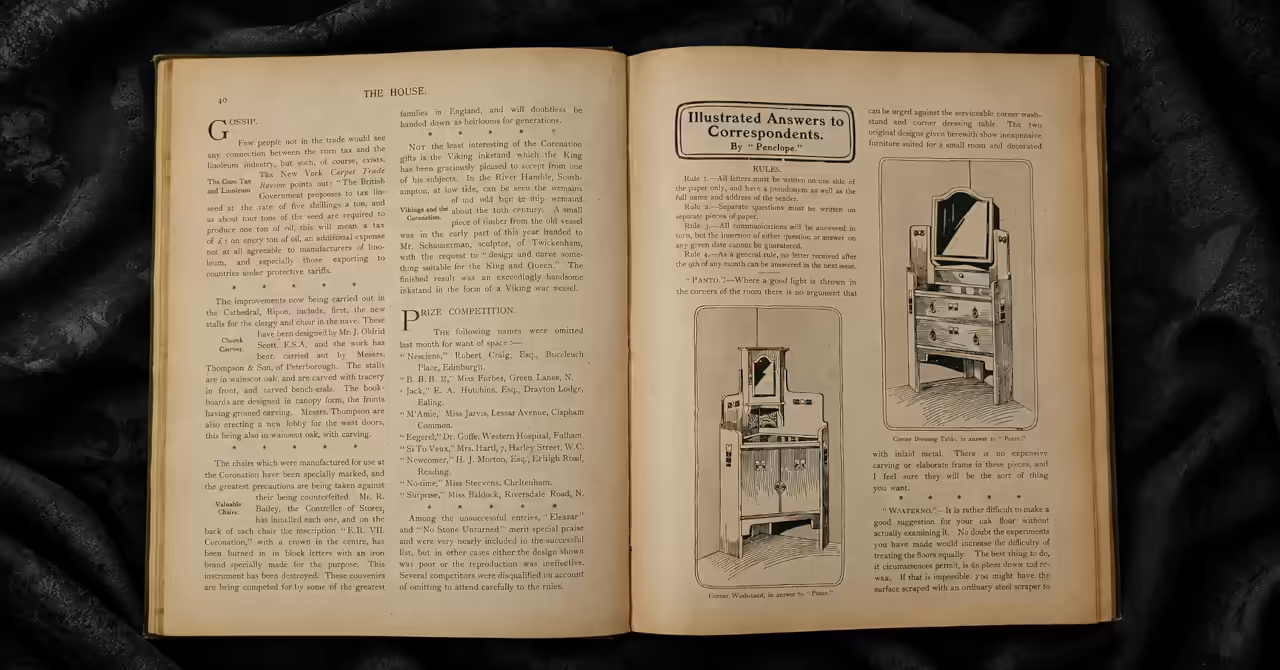
Few people not in the trade would see any connection between the corn tax and the linoleum industry, but such, of course, exists. It may be helpful to note that the word corn is a general term referring to a variety of grains. The New York Carpet Trade Review points out, "The Brtish Government proposes to tax linseed at the rate of five shillings a ton, and as about four tons of the seed are required to produce one ton of oil, this will mean a tax of £1 on every ton of oil, an additional expense not at all agreeable to manufacturers of linoleum, and especially those exporting to countries under protective tariffs.
☆ ☆ ☆ ☆ ☆
Church Carving
The improvements now being carried out in the Cathedral, Ripon, include, first, the new stalls for the clergy and choir in the nave. These have been designed by Mr J. Oldrid Scott, F.S.A and the work has been carried out by Messrs. Thompson & Son, of Peterborough. The stalls are in wainscot oak, and are carved with tracery in front, and carved bench-ends. The bookboards are designed in canopy form, the fronts having groined carving. Messrs. Thompson are also erecting a new lobby for the west doors, this being also in wainscot oak, with carving.
☆ ☆ ☆ ☆ ☆
Valuable Coronation Chairs
The chairs which were manufactured for use at the Coronation have been specially marked, and the greatest precautions are being taken against their being counterfeited. Mr. R. Bailey, the Controller of Stores, has initialled each one, and on the back of each chair the inscription "E.R. VII. Coronation," with a crown in the centre, has been burned in in block letters with an iron brand specially made for the purpose. This instrument has been destroyed. These souvenirs are being competed for by some of the greatest families in England, and will doubtless be handed down as heirlooms for generations.
☆ ☆ ☆ ☆ ☆
Vikings and the Coronation
Nor the least interesting of the Coronation gifts is the Viking inkstand which the King has been graciously pleased to accept from one of his subjects. In the River Hamble, Southampton, at low tide, can be seen the remains of an old Viking ship wrecked [Re-Editor: possibly referring to the Grace Dieu] about the 10th century. A small piece of timber from the old vessel was in the early part of this, year handed to Mr. Schauermann, sculptor, of Twickenham, with the request to "design and carve something suitable for the King and Queen." The finished result was an exceedingly handsome inkstand in the form of a Viking war vessel.
☆ ☆ ☆ ☆ ☆
Gossip about a walnut tree
A contemporary gives illustrations of a remarkable walnut tree, which appears to have filled a useful purpose in Italy in the eighteenth century. It is now in the hands a firm of Liverpool timber merchants. The following is a translation of the log’s history;
A Log with History
"Referring to the log of walnut you have purchased from my brother Antony last year, he got it from my deceased father, John Baptist, on April 24, 1892. My father got it on February 20, 1863, from Charles Dellanegra, who got it hereditarily from his mother, Ketty Cana, on September 28, 1840. Ketty Cana got it hereditarily from her father on April 6, 1788. The said John Baptist Cana was in possession of it before it was established in the Kent Roll of this Department, which was in 1768.
From an old legend existing in this Department it seems the said John Baptist Cana, who built up the wine press in 1747, obtained the walnut tree from one of his properties once possessed by Count Louis Salomone in the place called Isola in the territory of this Department. It is also said that there were not sufficient oxen in the region to carry the tree, which was yet green, to the place where the house was subsequently placed after having built the press. It was necessary to provide half a cow, with much bread and wine, to compensate the men who helped for the carrying of the famous log, which was considered as a rarity in the country of Senrevilla. This is all I have been able to get by searching in the archives of the Department, and by speaking with the oldest men of the country."
We may add that carved upon the side of the log are the figures 1747, which presumably indicate the year when it was first put to a useful purpose. The log is about 26ft. long and about 40in. square at the butt. Needless to say, it is perfectly dry and seasoned and thoroughly fit for conversion.
☆ ☆ ☆ ☆ ☆
Gossip about the Maharajah of Jaipur
Foreign Guests and their Cooking
The Maharajah of Jaipur, at Moray Lodge, at Campden Hill had a special kitchen built in a secluded spot, so that it could not be invaded or overlooked by low or no-caste individuals. The animals slaughtered for food had all to be males, and these had to be killed by a Brahmin.
For this purpose (says Food and Cookery) a temporary shrine to the goddess Kali was erected at Wimbledon, and there, before the idol, a priest decapitated the sheep and goats with one blow. The carcases were then dressed and sent up to the Hindoo princes and great folks. The cooks had to be of equally high caste as the princes, and consequently they were all impoverished Brahmins. All the cooking was done in beaten brass, tinned copper, and earthenware vessels placed over slow charcoal or wooden fires. A different set of arrangements, but almost as complicated, had to be made for the strict Mahomedan Indian and Moorish visitors.
☆ ☆ ☆ ☆ ☆
Chippendale and Sheraton furniture collection
Millionaires have sighed in vain for the Higham collection of Chippendale and Sheraton furniture owned by the family of that name, who have resided in Higham for centuries. The actual value of the collection of about fifty pieces is placed at £50,000, but Henry Grant the railway king, made an offer of £80,000 for it not long ago, which was refused. Some of the chairs cost £1,000 each, and date from the twelfth century.
Although the Highams work for their living as farmers, they have as yet stoutly declined any of the tempting offers which have been made for their treasures from time to time. Chairs sometimes prove expensive, and one in the King's collection at Windsor, which was once used at the coronation of the Venetian Doges and is dated 1670, cost 250 guineas; while two small Louis XIV. tables, sold by the Duke of Leeds in 1900, realised £15,000.
Pianos, too, although at all times costly, seldom fetch the prices which some millionaires are content to pay for them. Cornelius Vanderbilt gave £3,500 for one some time ago, and the Marquis of Breadalbane has one which cost only £500 less. If money is any guarantee, then the piano owned by Mr. Murand, a New York financier, must indeed be a sweet-toned instrument, for it cost £10,000.
The value, perhaps, lies more in the priceless paintings that adorn it and the patterns let into the woodwork in precious stones. Monarchs invariably spend fortunes in furnishings, and a decade ago the Sultan of Turkey decided to fit up a luxurious bedroom for his own use. The bed is of ivory and silver, the posts being incrusted with gems to represent the Imperial arms. The silk of which the hangings are made cost £80 a yard, and the tapestry on the walls is woven with gold thread and ablaze with diamonds, while even the ceiling is inlaid with gold. This piece of extravagance cost the Oriental potentate £120,000.
But probably the most expensive suite of furniture in existence is that owned by a certain Indian Maharajah. It consists of four arm chairs, three small tables and a sofa, all of solid ivory, and the suite is the more valuable because it was given to Warren Hastings by Tippoo Sahib. Five years ago an offer of £100,000, made by John Ashbury, the Californian millionaire, for the eight pieces of furniture as they stood, was refused.