From Art Nouveau Furniture to Early Modern Simplicity
·Revised
Introduction
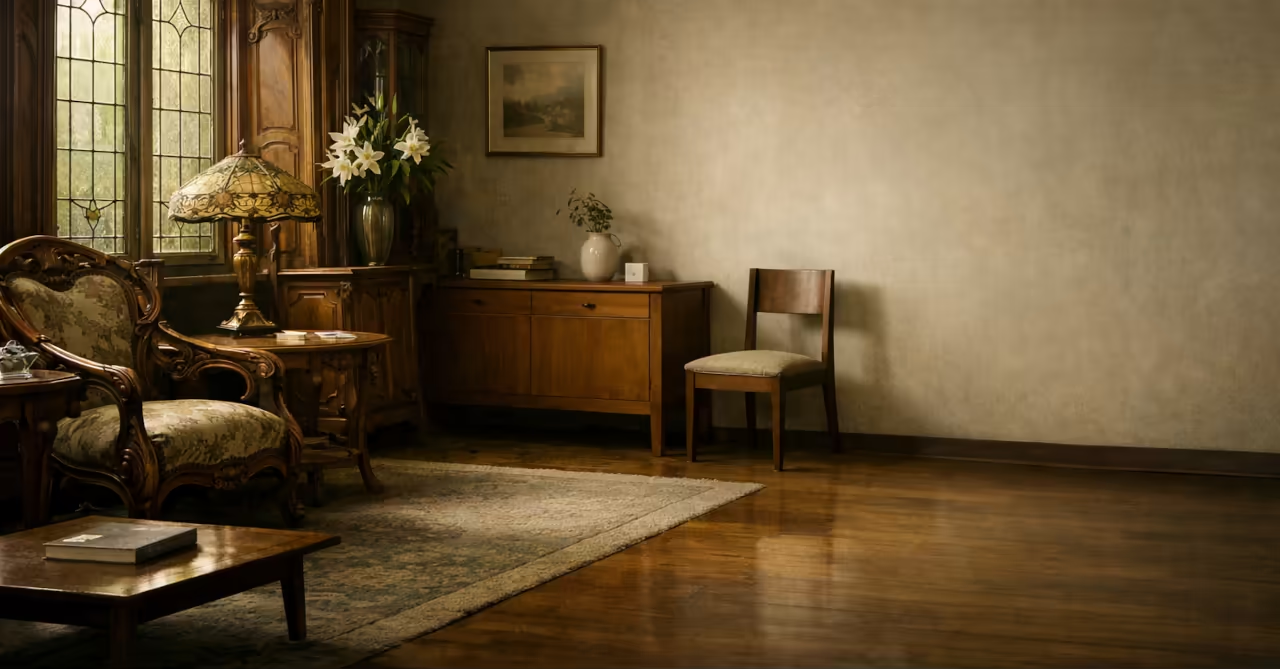
Art Nouveau furniture and early modern simplicity are often treated as opposites, yet one helped prepare the way for the other. The relationship is not obvious at first glance. Art Nouveau is remembered for curved lines, botanical motifs, expressive surfaces, and a restless desire to escape stale revival styles. Early modern simplicity is remembered for cleaner outlines, plainer surfaces, and a sharper respect for function. One seems decorative. The other seems corrective. Yet the path from one to the other is more direct than it first appears.
The bridge lies in a shared dissatisfaction with inherited convention. Art Nouveau rejected tired historic copying. It wanted furniture to feel alive, current, and suited to a new age. Early modern designers kept that impatience with dead formula, but they turned against excess within the new movement itself. Once buyers and makers accepted that old forms could be questioned, they became more willing to accept another step. They could now imagine furniture with less ornament, firmer outlines, and a calmer visual logic.
That shift did not happen in a single leap. It happened through fatigue, refinement, and adjustment. A public that had learned to tolerate novelty through Art Nouveau could also learn to prefer restraint once novelty became too insistent. In that sense, the road to simplicity was partly cleared by the very movement that seemed most committed to visual flourish.
How excess prepared the ground for restraint
The key relationship is simple. Art Nouveau weakened the authority of historical imitation, and that opened the door to furniture that no longer needed heavy ornament to justify itself. Once the old rulebook lost its grip, design could move in two directions. It could become more expressive, as Art Nouveau often did, or it could become more disciplined, as later modern design preferred. The second path became easier because the first had already done the rebellious work.
This helps explain why early modern simplicity did not emerge from nowhere. It did not merely replace Art Nouveau as if one fashion erased another. It inherited a changed mental landscape. Designers, cabinetmakers, critics, and buyers had already been taught to see furniture as something that could be rethought from first principles. What should a chair look like. How much decoration should a cabinet carry. When does ornament enrich a piece, and when does it burden it. Those questions had already been forced into the open.
Art Nouveau also exposed the limits of decorative freedom. In its most successful forms, it gave furniture freshness and movement. In its weaker forms, it risked making furniture look unstable, overworked, or too eager to impress. That strain produced a reaction. Simpler design began to look not dull, but mature. Straight lines, measured proportion, quiet surfaces, and selective detail could now appear modern in a deeper way. They suggested confidence rather than display.
How practicality forced design refinement
The mechanism of change was not only aesthetic. It was commercial and practical. Makers had to sell furniture into real rooms, not theoretical ones. Buyers might admire experiment in a showroom, yet hesitate when faced with the demands of daily use. Furniture has to live with walls, textiles, fireplaces, light, and the habits of a household. It must hold its place over time. Art Nouveau expanded the range of acceptable form, but it also tested the patience of buyers who wanted novelty without visual disorder.
That pressure encouraged moderation. Designers began to retain the modern spirit while reducing the noise. Curves became less wayward. natural motifs were more controlled. structure became easier to read. Surfaces breathed. Ornament was no longer expected to carry the full burden of artistic identity. Instead, proportion, silhouette, and material began to do more of the work. This was the crucial technical shift. Modernity moved from decoration to structure.
Once that happened, simplicity no longer looked like a lack. It looked like refinement. A room could feel current without needing every object to announce itself. A sideboard could be modern because it was resolved, not because it was theatrical. That practical learning process helped turn a decorative revolution into a disciplined one.
Why contrast sharpened the case for simplicity
The contrast between Art Nouveau and early modern simplicity is therefore real, but it should not be exaggerated. Art Nouveau often sought beauty through movement, association, and expressive detail. Early modern simplicity sought beauty through order, reduction, and visual calm. The difference is clear. One invites the eye to wander. The other invites the eye to settle. Yet both belong to the same larger story of design escaping from stale repetition.
The implication is important for how we read style change. We often imagine progress as a neat sequence of winners and losers. A style rises, proves itself, and is then swept aside by a better answer. Furniture history is rarely that clean. A movement may fail in one respect while succeeding in another. Art Nouveau may have overreached in some furniture, yet it still taught the market to expect invention. It loosened habits. It widened permission. It made it possible to judge furniture by present needs rather than inherited prestige alone.
That is why simplicity should not be read as a retreat into safety. In its best form, it was a sharpened continuation of the modern impulse. It took the right to reinvent form and joined it to restraint. It kept the freedom, but discarded the strain.
How the pattern still shapes taste today
This relationship still has value now because the cycle has not disappeared. Design repeatedly swings between exuberance and restraint. A new visual language arrives. It excites people because it breaks habit. Then it spreads too widely, or becomes too mannered, and a quieter correction follows. What changes are the materials and the slogans. The underlying pattern remains familiar.
For readers interested in vintage interiors, this offers a better way to judge transitional furniture. It is not enough to ask whether a piece is ornate or plain. The better question is what kind of modernity it is trying to express. Is it still proving that convention can be broken. Or is it showing that freedom has matured into control. That distinction makes many early twentieth-century interiors easier to understand.
It also helps when reading period criticism. Writers who attacked excess were not always enemies of innovation. Often they were asking for a more durable version of it. Their preference for cleaner lines and reduced ornament may sound conservative at first, yet it can reflect a very modern desire for coherence, legibility, and use.
Conclusion
The movement from Art Nouveau to early modern simplicity was not a sharp break between decoration and discipline. It was a transition within modern design itself. Art Nouveau challenged inherited forms and made invention respectable. Its excesses then made restraint newly attractive. Out of that sequence came furniture that could be modern without being crowded, expressive without being restless, and fresh without leaning on historical costume.
The next useful step is to look more closely at where this refinement became visible in actual rooms. Fireplaces, leaded glass, textiles, and simplified cabinet forms often show the shift better than manifestos do. From there, the larger question opens naturally: when does moderation preserve life in a style, and when does it drain that life away?
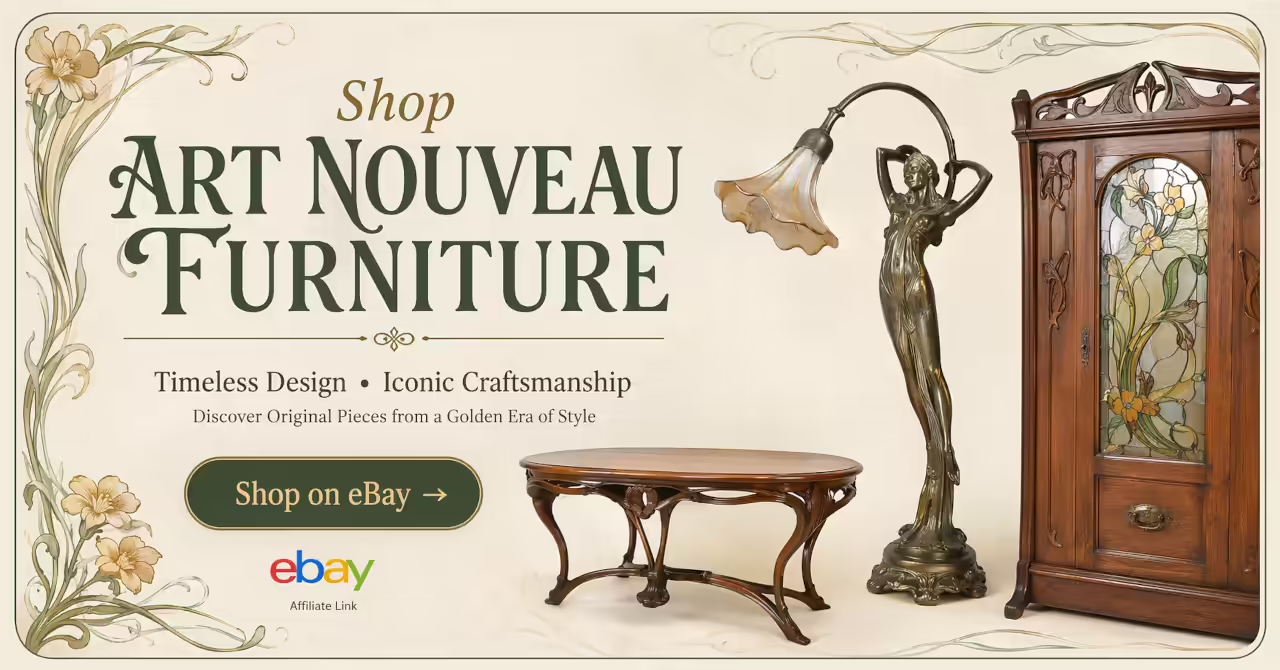
Collector market snapshot: The linked eBay catalogue reflects a diverse and visually rich market for Art Nouveau furniture and decorative objects. Collectors can expect to encounter carved timber tables, cabinets with floral marquetry or stained glass panels, sinuous mirrors, lighting, and smaller decorative pieces such as clocks and stands. Listings range from fully restored showcase items to pieces requiring conservation, with condition notes often highlighting wear to finishes, repairs, or missing elements. Pricing typically spans from accessible decorative items in the lower hundreds through to more substantial or refined pieces reaching into the low thousands, particularly where craftsmanship, material quality, or completeness is evident. For most collectors, the appeal lies in the distinctive flowing lines, organic motifs, and the opportunity to acquire a functional artefact that embodies the aesthetic ideals of the period.
Author's Notes
There is something quietly revealing about placing an Art Nouveau chair beside a more restrained early modern piece. One feels eager to speak, the other content to listen. I found myself drawn to that contrast while handling a few reference pieces and images. The carved flourishes, the insistence on movement, the desire to be noticed. Then, just as suddenly, the calm of a simpler form that seems to trust its own balance. It made me wonder not which is better, but which feels easier to live with over time.
I spent some time with a small stack of interior magazine from the early 1900s, and what struck me was not just the furniture, but the mood of the rooms themselves. There is a point where decoration begins to soften, where heavy pattern gives way to something quieter. Even the textiles seem to breathe differently. When I compared ornate brocades with simpler weaves, the difference was not only visual. It felt emotional. One creates a sense of occasion, the other a sense of ease. Both have their place, but they speak to different ways of living.
What I keep returning to are the photographs. Black and white interiors have a way of stripping things back to essentials. Without colour, you begin to notice proportion, spacing, and light in a more honest way. A room either holds together or it does not. In those images, the shift becomes clear. Furniture begins to settle into the room rather than compete within it. That quiet adjustment says more about changing taste than any single object ever could.
Notes & Memoranda
Glossary
- Art Nouveau
- In this article, Art Nouveau refers to a late nineteenth and early twentieth century design movement characterised by flowing lines, natural forms, and decorative surfaces, used here as a catalyst for breaking away from historical furniture styles.
- Early Modern Simplicity
- In this article, early modern simplicity refers to a transitional design approach that favoured cleaner lines, restrained ornament, and clarity of form, emerging as a refinement of earlier modern experiments rather than a complete rejection.
- Historical Revival
- In this article, historical revival describes the practice of drawing on past styles such as Gothic, Georgian, or Renaissance furniture, often reproduced or adapted for contemporary interiors before the rise of modern design movements.
- Ornament
- In this article, ornament refers to decorative elements applied to furniture, such as carving, inlay, or surface detail, which may enhance or, in some cases, overwhelm the clarity and function of a piece.
- Proportion
- In this article, proportion refers to the relationship between parts of a furniture piece, including height, width, and depth, used as a key measure of visual balance and design quality beyond decoration.
- Visual Restraint
- In this article, visual restraint refers to the controlled use of decoration and form, where simplicity and clarity are prioritised over expressive or excessive detail in furniture design.
- Modernity
- In this article, modernity refers to the desire for furniture to reflect contemporary life and thinking, rather than copying historical styles, often expressed through innovation in form, material, or purpose.
- Structural Clarity
- In this article, structural clarity refers to the ease with which a furniture piece communicates how it is made and how it functions, with visible logic in its construction and form.
- Cabinetmaker
- In this article, a cabinetmaker refers to a skilled craftsperson who designs and constructs fine furniture, often adapting broader design trends into practical and saleable forms for domestic interiors.
- Design Transition
- In this article, design transition refers to the gradual shift in furniture styles from expressive, decorative forms toward more restrained and simplified designs, shaped by changing taste, criticism, and practical use.
Frequently asked questions
Why did Art Nouveau fall out of favour so quickly?
Art Nouveau fell out of favour quickly in furniture because its most expressive forms could feel visually restless, expensive, and difficult to live with over time. What first seemed fresh and daring could soon appear overworked. As buyers and makers looked for a more durable version of modern taste, cleaner lines and reduced ornament became more attractive.
Was Art Nouveau considered impractical furniture?
Some Art Nouveau furniture was seen as impractical, especially when natural forms and decorative effects began to overwhelm clear structure or everyday comfort. Critics did not reject all innovation, but they were wary of pieces where artistic ambition seemed to weaken recognisable function. The strongest designs balanced novelty with usability.
How did early modern furniture differ from Art Nouveau?
Early modern furniture generally preferred cleaner outlines, calmer surfaces, and less visible ornament than Art Nouveau. Where Art Nouveau often used flowing curves, floral motifs, and expressive detail, early modern design aimed for restraint, proportion, and clarity. The shift was not a total rejection of modernity, but a refinement of it.
Did Art Nouveau influence later modernist design?
Yes. Art Nouveau influenced later modernist design by helping break the authority of historical imitation. It taught designers and buyers that furniture could be rethought for a new age rather than copied from older styles. Even where modernists rejected its ornament, they inherited its willingness to question tradition and pursue a contemporary design language.
Further Reading…


References
- The Decline of L'Art Nouveau, phillaneum.com [retrieved 2026-04-03]
- Old vs New Furniturey, phillaneum.com [retrieved 2025-12-13]
Disclosure
This article presents an interpretive examination of early twentieth century furniture design, based on selected period writings and editorial analysis. It reflects a contemporary reading of shifting taste between Art Nouveau and early modern simplicity rather than a definitive historical account. Readers seeking primary understanding should consult original sources and period publications.