Kodak's New Reception Rooms

The ever increasing popularity of photography is not entirely due to the inherent charms of that most fascinating of pursuits. The art as Daguerre left it was rather one to be pursued by scientific men than likely to gain favour among amateurs, a class frequently and unjustly believed to be as fond of reaping as they are averse to sowing in their hobbies. As advances were made, however, the ranks of photographers received accessions from the extensive semi-scientific fringe.
A Charming Rendezvous
Ten years ago a man who was adept with the camera was regarded much in the same light as nowadays one would be who went in for model engineering, lathe-turning, or any like hobby. But soon a popularising force came into being, and under the motto, You touch the button and we do the rest, the firm of Kodak made it clear that, without preliminary training, any person might, in a short time, produce photographic pictures, clear, and in every respect worthy to be retained in some permanent form.
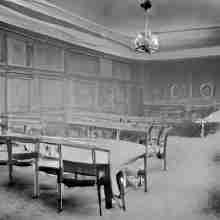
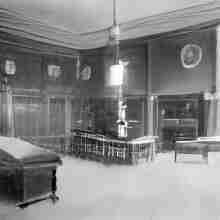
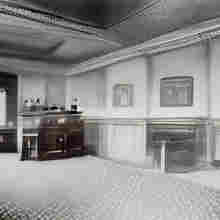
The enormous success which attended this experiment is not, on the whole, surprising. Even now people who regard photography as a technical matter are becoming convinced every day ot its simplicity, and are joining the army of "Camerists." The tremendous popularity of the Kodak cameras is testified to by the fact that this large firm has considered it worth while to fit up at their head offices in Clerkenwell Road, a suite of reception rooms for their customers. The furnishing of these rooms is carried out in accordance wiih those modern ideas which appear to have prevailed in the design of the shop fronts of Kodak’s retail branches In considering the suitability of the style of decoration, we must remember the circumstances for which it is designed, and the opinion is not exaggerated which declares that these reception rooms constitute a very high artistic achievement.

The woodwork is uniformly white enamelled and the walls are covered with grey canvas. The decoration of the filling, or the wide frieze, is brown and black, and the furniture light oak. Of course, a great deal of the space in the room is devoted to a display of photographs, which harmonise perfectly with the artistic aspect of the decoration. Quaint little beaten iron lamps, hanging from the picture moulding, throw a beautiful light on the photo¬ graphs which are on the walls. In one of the rooms the iron is changed for copper fittings; the frieze is in terra-cotta, while in the board room the frieze is in purple and greens. The furniture is light oak, covered with a most charming purple leather.
However, it is not the furniture and decoration which will attract most of the visitors to these reception rooms. Indeed, the large majority of those present on 8th September 1902, when the rooms were opened, were evidently ardently interested in the photographic work shown. There is, of course, photography and photography, and while the difference between good and bad work is enormous, it is not easy to describe.
The enlargements on the walls were particularly striking, and afford significant evidence of the value of the Kodak machine, inasmuch as the slightest flaw, which might pass unnoticed in a small photograph, would be a prominent feature of the enlargement, and it is needless to say that any such flaws were conspicuously absent. Among a host of interesting photographic appliances, the one which attracted most attention was undoubtedly the new developing machine lately placed on the market. The necessities which previously existed for a dark room and the groping about and general discomfort consequent on the exclusion of light, have been made a thing of the past.
The motto now is, "You touch the button and you do the rest." The new machine shows how the rest is to be done, so that without any fear of staining the fingers, or any necessity for a dark room at all, the films may be easily developed. This invention may well be called one of the most important steps in the advance of photography during recent years, and if only half the number of those who possess Kodak—and this is a very small estimate—purchase this developing machine. The commercial success of the Kodak developing machine is absolutely assured.
The illustrations which accompany these remarks give some idea of recent successes of the Kodak machines. Unfortunately, in the processes of engraving and printing, a great deal of the definition and beauty of the light and shade is lost.