Lessons in Woodcarving.—II.
Modelling and finishing the surface
Before taking up my subject where I left it last month (Lessons in Woodcarving I), a few words of recapitulation, in connection with the carving for a Smoker's Companion which appears as part of the special supplement, may be helpful to new readers.
First, then, the detail sketch must be carefully transferred to the wood, and then the outlines must be set in, as described in the first lesson. The ground which is stippled in the drawing will be taken down a little and cleared with a router, and afterwards stamped with a punch. I have been asked whether this stamping must be done before or after the modelling of the leaves and stems is attempted. The answer is that it must be done before, because if the instrument should chance to slip, any damage it may do to the decorative part of the design may be repaired in the modelling. The drawing may appear a little indefinite as regards the exact place where the stamping is to stop in the panel of the door. This is simple enough, however. Either of the two courses may be adopted.
The stems may be approached until they touch, and the stamping will terminate above them, or the lower leaves may be brought together, and the stamping continue as far as them. In either case, my idea is to have the centre of the design rather higher than the rest, so as to give a fulness to it and a certain character to the whole panel.
The next part of the work is to model carefully the flowers. A point in connection with them to be noticed is that the edges should be what is called lipped or curled. The relief is low, and unless a slight undercut like this is given the design may look flat and lifeless. There is nothing so helpful to beginners at woodcarving as having the opportunity of inspecting good pieces, and if my readers will do this they will observe that in the best low relief work—not, of course, mere strap work or scratch carving—this lipping frequently occurs. It corresponds, in fact, to shading in a drawing, or to the lines which are put round a map to bring up the outline of the country depicted.
The carving for the pediment and the bracket is very similar to that in the panel. The ground is cleared and stamped in exactly the same way, and the modelling done, as in the other case, mostly with flat gouges. In the panel, the stems at the side will have to be lowered slightly where they go under the buds. This remark applies also to the pediment and the bracket; in the latter the carver must give a quick hollow with the bent gouge—this in the place shaded.
A reference to the supplement will make my meaning clear. So much for the modelling generally. The work must be completed with a veiner to give the sharp effects. For the finishing-up, a little fine glass-paper may be used. If painting is intended, the carving must be made deeper, for, although oil colour is an excellent preservative for the wood, it has the effect, as it obviously must, of dulling the crispness and definition of the work.
The Smoker's Companion, to which the carving is applied, may be made with the help of a little experience in carpentry. The illustration however, is taken from the catalogue of Abbott Brothers, of Southall, and the number is C 264. It may be obtained from any of the firm&apso;s agents, and they include most retail houses that deal in fancy articles at all.
Next month I hope to take the opportunity to say a few words on what is called scratch carving. This, of course, is quite distinct from chip carving, and provides a means for decorative woodwork without the labour of cutting away the ground, as is necessary in most deep carving.
WOODCARVER.
The first of this series of articles appeared in the October Number, obtainable from the publishers.
More on woodcarving
☆ ☆ ☆ ☆ ☆
[Re-Editor's Notes]
Woodbox Carving Ideas
Woodcarving is a form of sculpture in which wood is carved using a variety of tools such as knives, chisels, and gouges. It is an ancient art form that has been practiced for thousands of years and is still popular today. Woodcarvers create a wide range of objects including figurines, animals, decorative objects, and practical items such as spoons and bowls. The finished objects can be left in their natural wood state, or they can be painted or stained. Woodcarving requires a high level of skill and can be done by hand or using power tools. It is a rewarding and satisfying craft that allows the creator to bring their artistic vision to life.
woodcarving was a popular activity during the Arts and Crafts movement, which was a social and artistic movement that began in Britain in the late 19th century and spread to other parts of the world, including the United States. The Arts and Crafts movement was a reaction against the mass-produced, machine-made goods that were becoming increasingly common at the time. Proponents of the movement believed in the importance of traditional craftsmanship and the value of creating objects by hand. Woodcarving, along with other crafts such as pottery, metalworking, and textiles, was celebrated as a way to create beautiful, functional objects using traditional techniques. The Arts and Crafts movement had a significant influence on design and architecture, and it continues to be influential today.
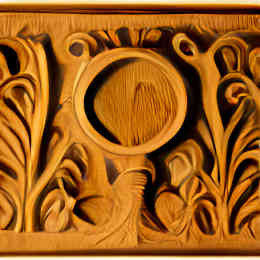
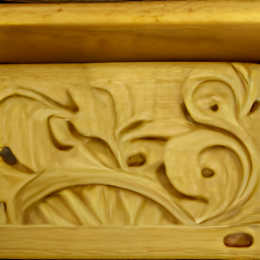
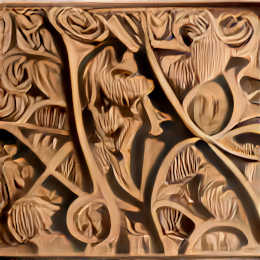
The supplement that that article refers to has been lost to time. Once again, I've turned to artificial intelligence to develop original woodcarving ideas. These images show an organic texture that can be used in our crafts.
The House Re-Editor